

File To String
Reads the whole content of a text file into a text variable.
File To String reads a file and gives you its content as text. Use it to read a .txt, .csv, .json, .xml or .html file that a user uploaded or that another action produced, so that you can parse it or send it further.
Add the action
In the Process Designer toolbox, open Documents and pick File To String (or type File To String in the search box).
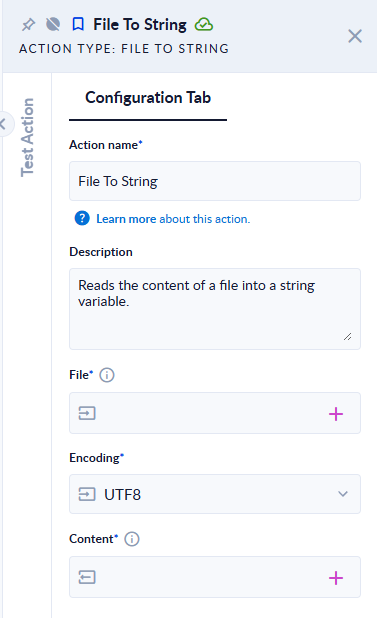
Inputs and outputs
| Field | Direction | Type | Required | What to put / what you get |
|---|---|---|---|---|
| File | Input | File | Yes | The file to read. |
| Encoding | Input | Option | Yes | The character set the file was saved in. Default UTF8. Also: UTF32, ASCII, Unicode (UTF-16), BigEndianUnicode, Latin1 and Windows code pages 1250–1258. |
| Content | Output | Text | Yes | The content of the file. |
Example
A file hello.txt saved as UTF-8 with the lines Hello, PROCESIO! and Second line ăîș:
| Encoding | Content |
|---|---|
| UTF8 | Hello, PROCESIO! and Second line ăîș on two lines |
| Latin1 | Hello, PROCESIO! is right, but each letter with a diacritic turns into two other characters (î becomes î) |
Good to know
- Pick the encoding the file was saved in. A wrong choice does not fail the step; it only gives wrong characters.
- A byte order mark (BOM) at the start of the file is recognised and not included in Content.
- Line breaks are kept as they are in the file.
- The action is meant for text. A binary file (PDF, image, Excel, zip) gives unreadable text; use File To Base64 to carry such a file as text.
- To turn the text into an object, follow with a JSON action. To read several files at once, use Read Files Content.