

Platform Tricks
Here you'll find a list of tricks to improve your experience when working with PROCESIO.
Here you'll find a list of tricks to improve your experience when working with PROCESIO.
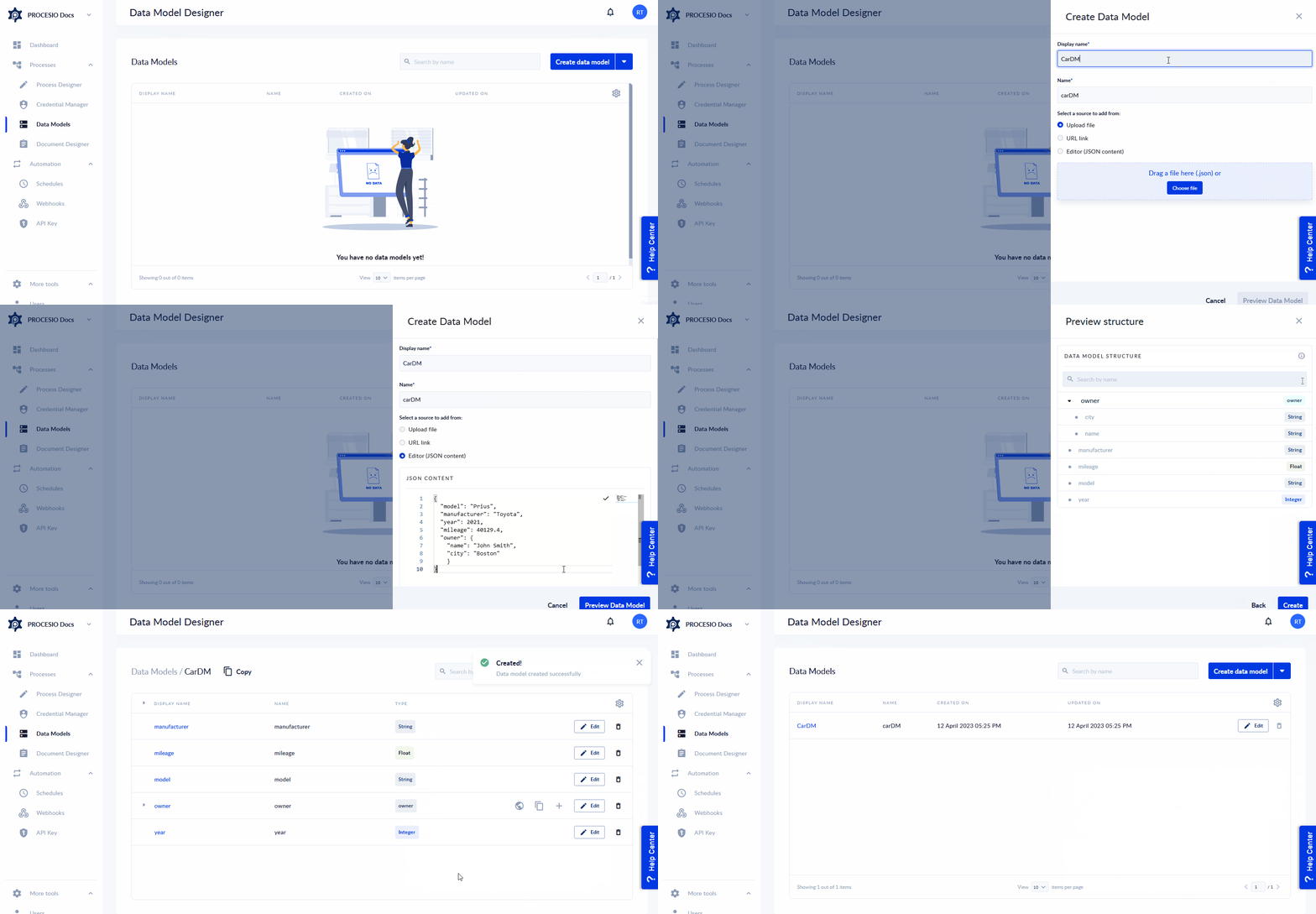
Creating a Data Model from JSON
JSON Example:
{ "model": "Prius", "manufacturer": "Toyota", "year": 2021, "mileage": 40129.4, "owner": { "name": "John Smith", "city": "Boston" } }
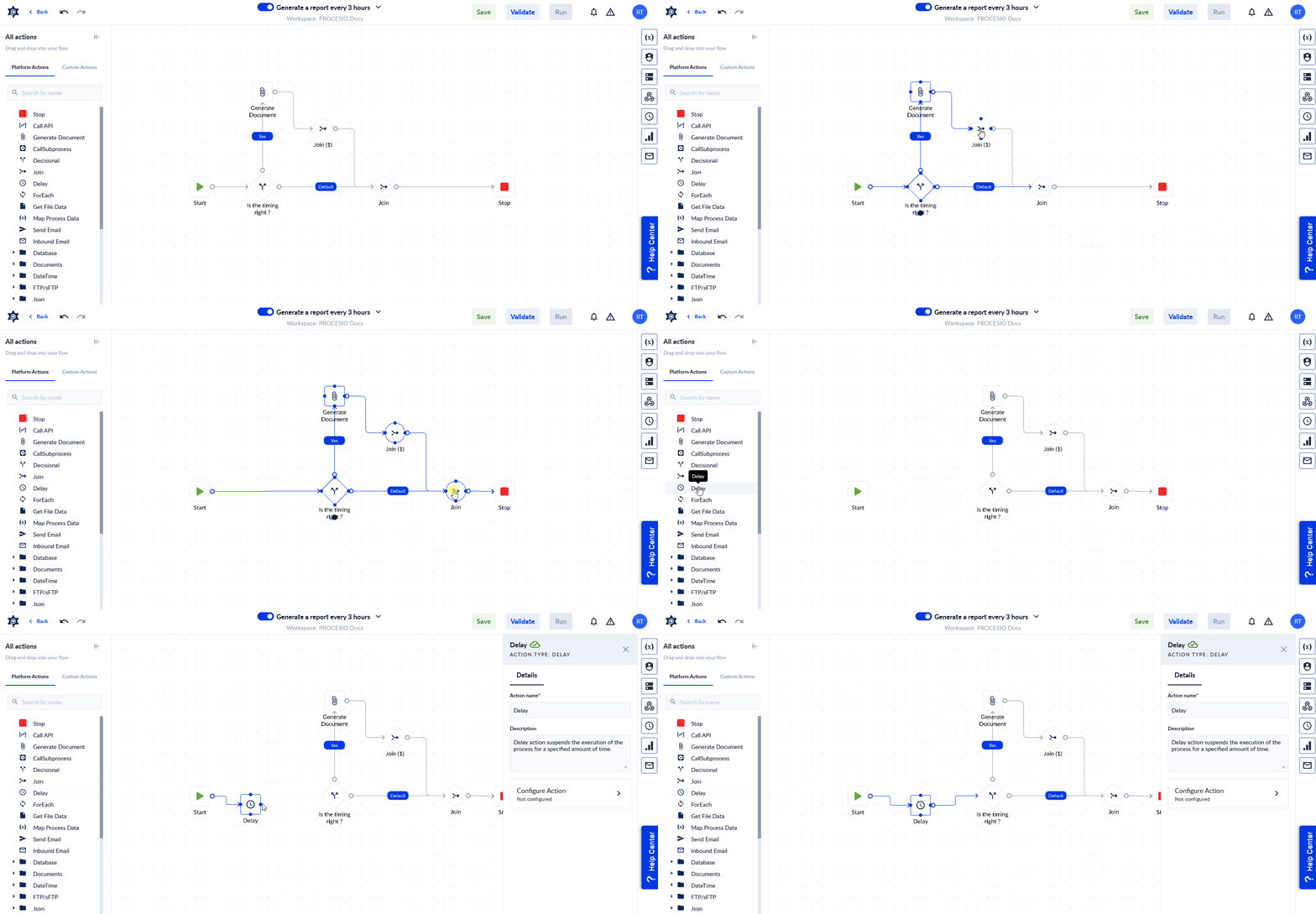
Moving multiple actions together inside the canvas
- Hold down the CTRL key and click every action that you want to move.
- Release the CTRL key and just drag the group like you would drag a single action.
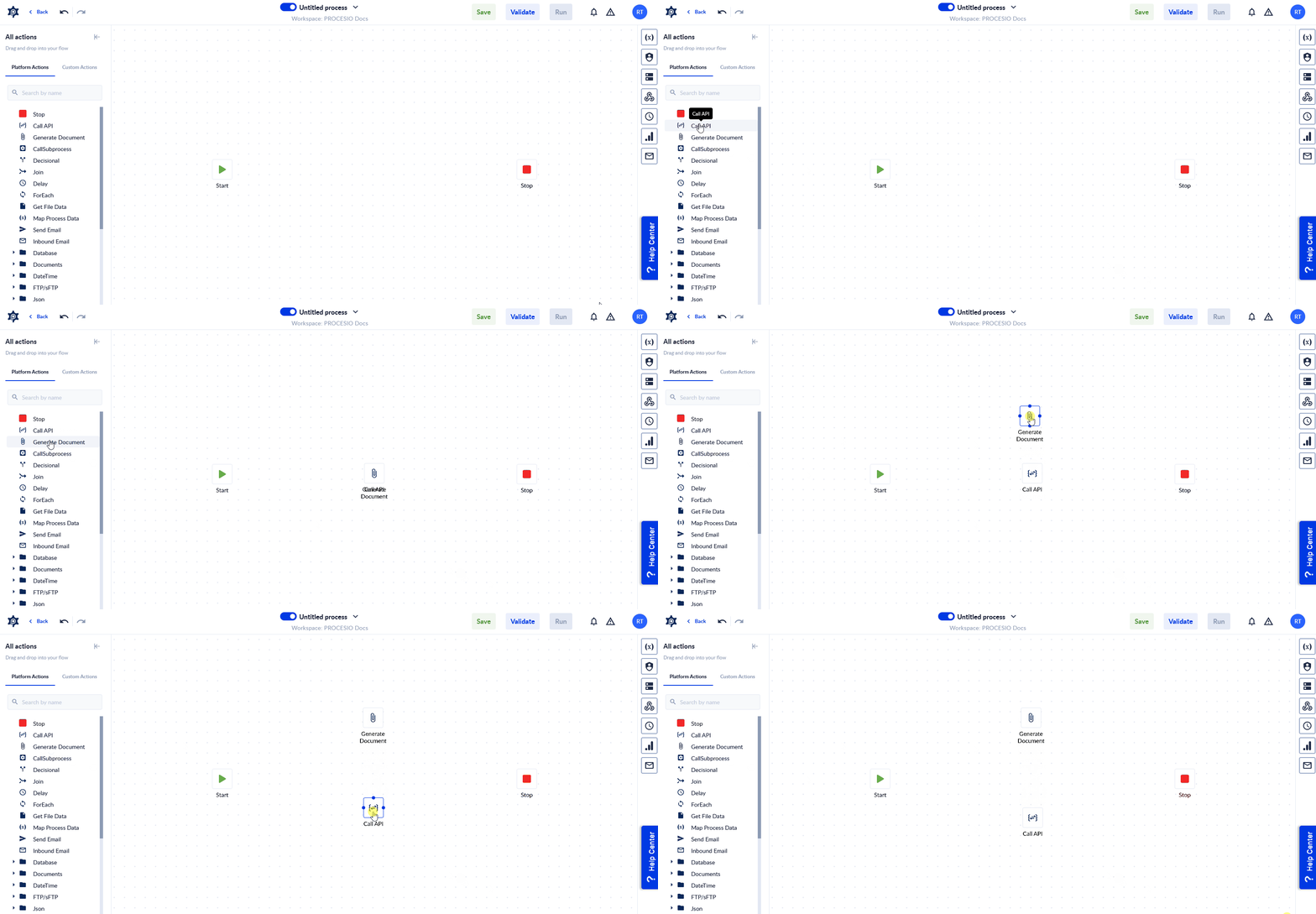
Spawning an action on canvas without dragging it
- Double-click the action you want to spawn and a new one will show up in the middle of the canvas.
Copying and pasting actions
Instead of configuring the same action twice, copy the one you already set up — the copy keeps its whole configuration.
- Click the action on the canvas to select it. Hold CTRL and click to select several.
- Press CTRL + C (CMD + C on a Mac).
- Click where you want the copy to land, then press CTRL + V (CMD + V on a Mac).
The canvas needs the keyboard focus, so click an empty part of it first. Straight after typing in a properties panel or in the toolbox search box the focus is still there, and copy and paste do nothing — nothing is lost, just click the canvas and press them again.
A few details worth knowing:
- The copy lands where you last clicked, not on top of the original. Pasting several at once keeps their positions relative to each other.
- The copy's name gets a number, so a copy of Format name becomes Format name (1), then (2), and so on. Rename it to something meaningful.
- Not every action can be copied. A custom action declares whether it may be, with
CanDuplicate. Duplicate in the action's right-click menu does the same thing in one step. - Shapes are not copied this way. Drag another one from the toolbar instead — see Canvas shapes.
The right-click menu on an action
Right-click any action on the canvas:
| Entry | What it does |
|---|---|
| Duplicate | Drops a configured copy of the action on the canvas. |
| Save action as a template | Keeps this configuration in the Toolbar to reuse later — see Save action as a template. |
| Toggle breakpoint | Marks the action so a debug run pauses there — see Debug a process. |
| Toggle disabled state | Keeps the action in the process but stops it running — see Disabling an action. |
| Delete | Removes the action and its connections. |
An entry only appears when that action supports it. Start and Stop, for example, offer neither a breakpoint nor a disabled state, so those entries are simply not in their menu.
Press Esc to close the menu without choosing anything — a click elsewhere on the canvas closes it too. See Keyboard shortcuts.
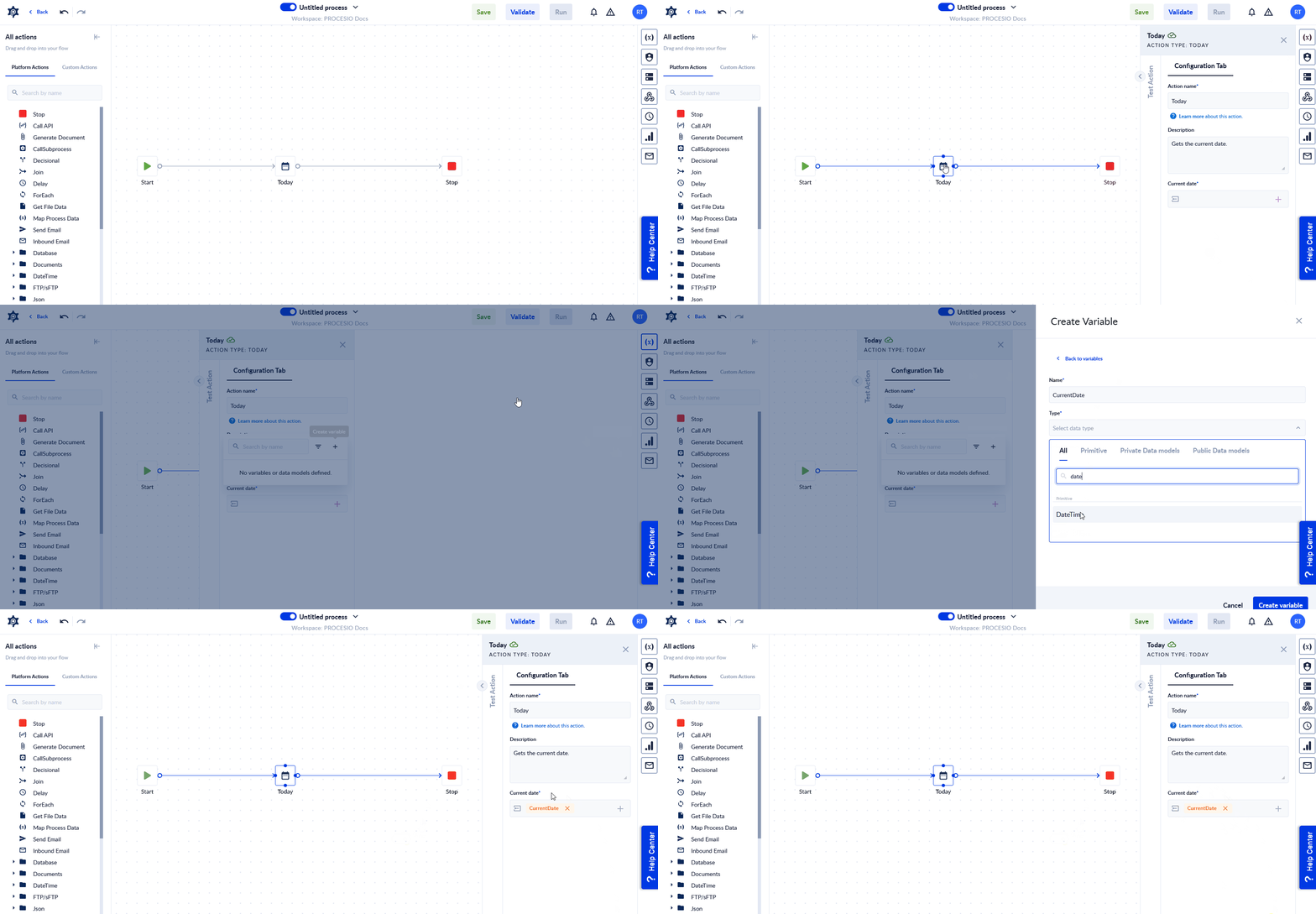
Create and assign a variable in one step
You do not have to create a variable first and then come back to use it. Create it from the field that needs it, and it is assigned there straight away.
- In the action's field, open the variables selector (CTRL + I, or CMD + I on a Mac).
- Type the name you want to give the variable in the search box.
- Click + (Create variable).
The dialog opens already filled in for that field: the name you typed, the data type the field expects, and whether it expects a list. Confirm it, and the new variable is created and assigned to the field in one step.
Full-screen code editor
- Click inside the code editor.
- Use the ESC key to toggle the full-screen on and off.
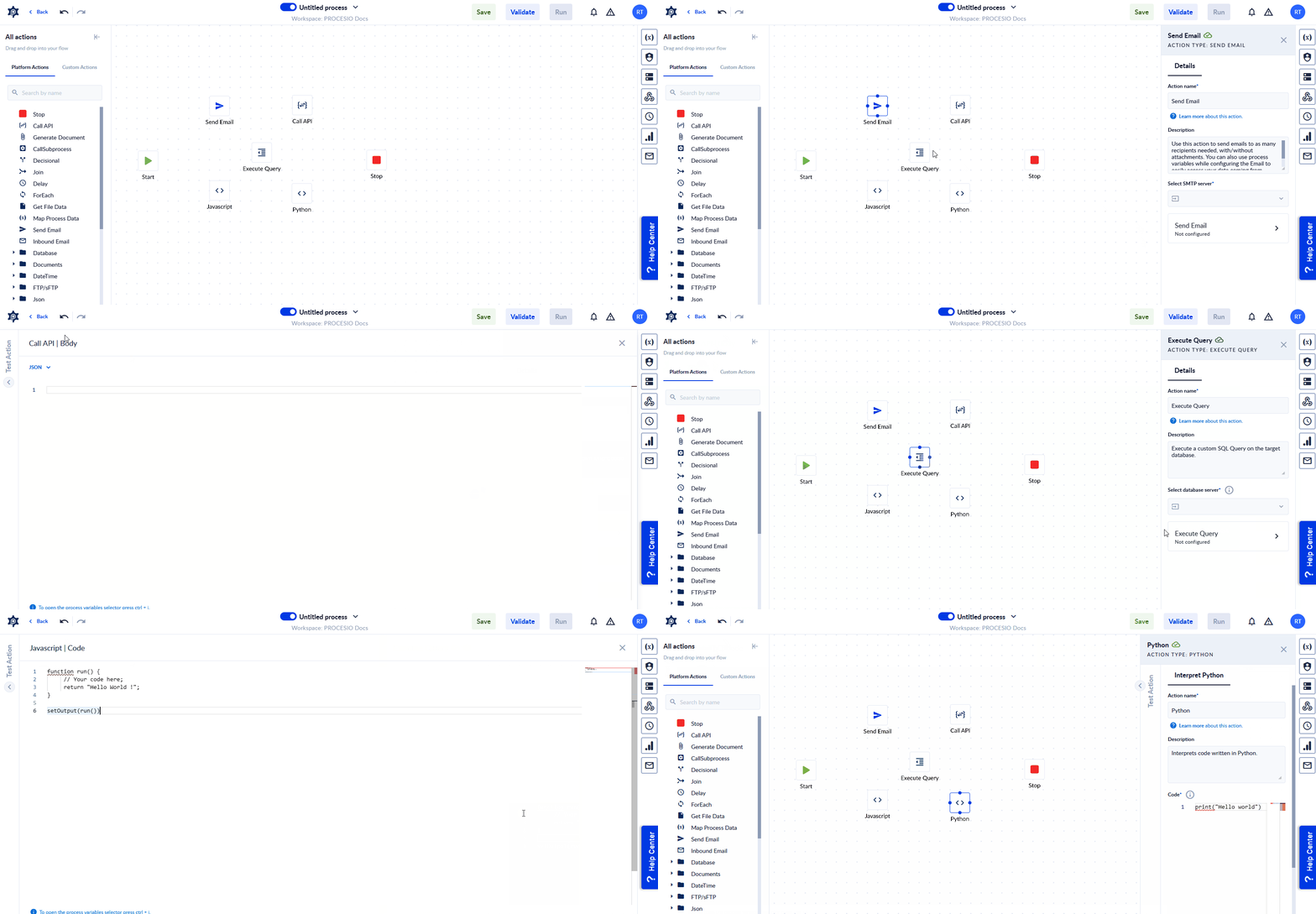
SHIFT + ALT + F reformats and re-indents what is in the editor — handy on a block of JSON or code that arrived as one long line. Format Document in the editor's own right-click menu does the same thing.
Saving with the keyboard
- Press CTRL + S (CMD + S on a Mac) to save the process, instead of reaching for the Save button.
All of these combinations can be changed to ones you prefer — see Keyboard shortcuts for the full list and how to edit them.
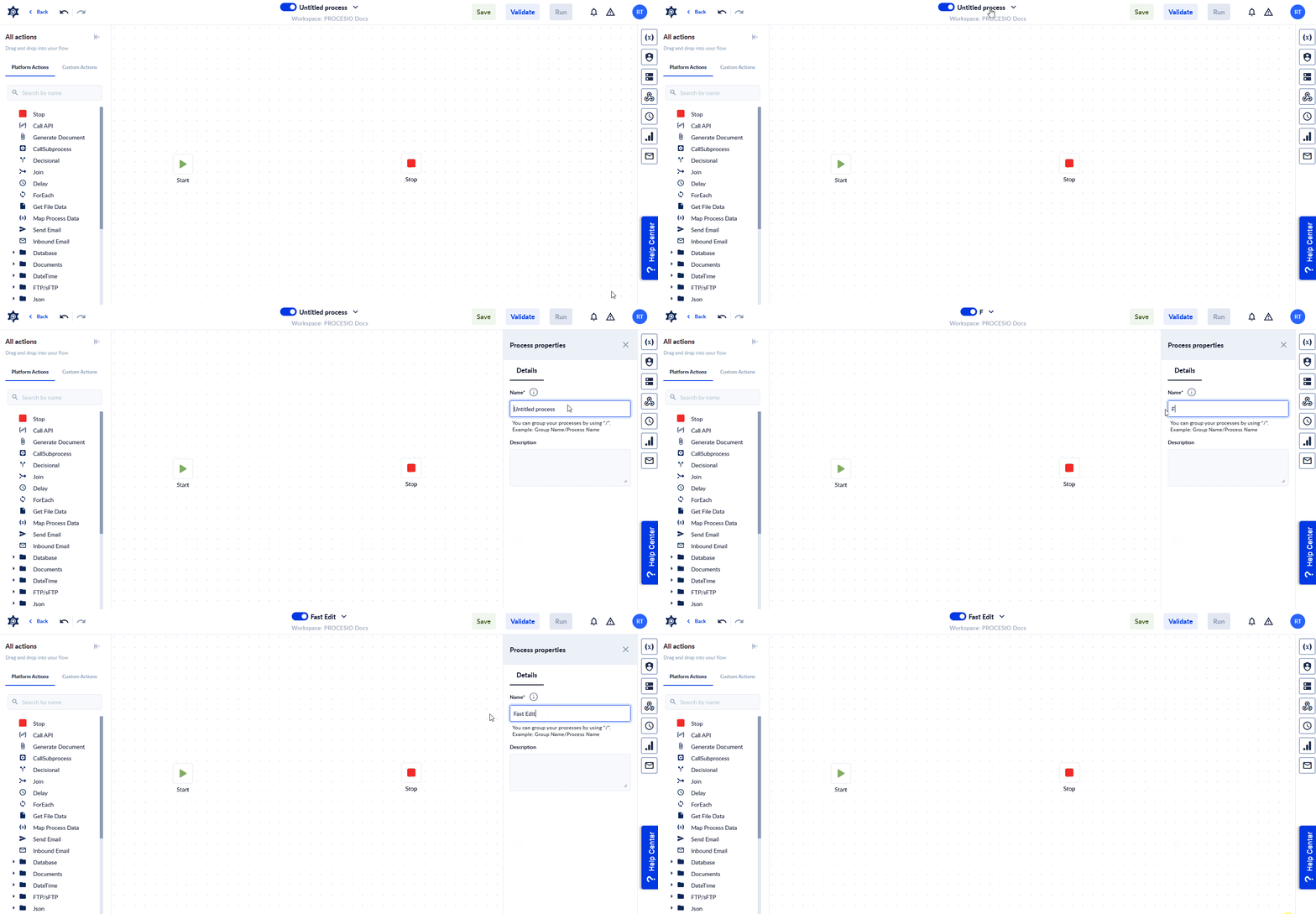
Editing process properties faster
- You can double-click on the process name inside the canvas to edit the process properties.
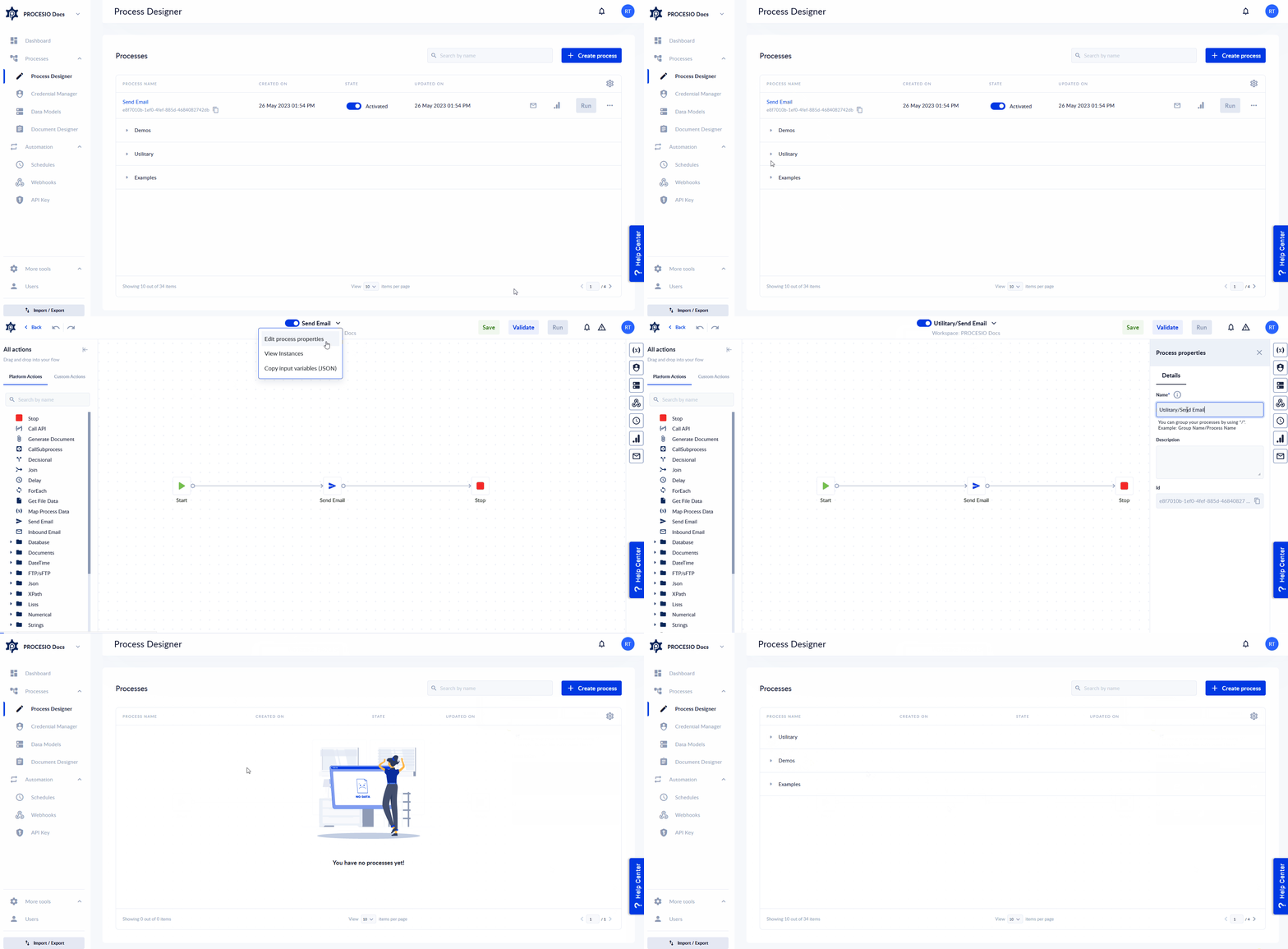
Grouping processes in the Process Designer
- Use Group/Name pattern when naming your processes to group them.
Duplicating a whole process
Duplicate in a process row's contextual menu copies the entire process — every action, with its configuration.
The copy is created inactive. It will not be triggered by its webhook or started by its schedules until you switch it on with the activation toggle. That is deliberate: it stops a half-edited copy from running on the original's triggers.
- The copy is named after the original with (Copy) on the end, so Orders/Daily report becomes Orders/Daily report (Copy) — which keeps it in the same group.
- If the original has a webhook assigned, you are warned first: the copy is assigned the same webhook.
- Rename the copy before you activate it, so the two are easy to tell apart.