

Process runs and history
Run a process, follow its runs in the Recent and History lists, filter them, open a run's details, and restore a process from the version a run used.
Every time a process runs, PROCESIO records the run (an instance). This page explains how to start a run, where to find your runs, how to read a run's details, and how to bring back the version of the process that a run used.
Run a process
The Run button is available only when the process is saved, valid and active.
You can start a run in three ways:
- From the Process Designer topbar, with the Run button.

- From the validation message, with the Run process button.

- From the process list in Process Designer.

If the process has no Input variables, it starts as soon as you click Run.
If the process has Input variables, a dialog asks for their values first. Give each one a value of its own type: upload a file for a File variable, and write JSON for a Data Model variable. Then click Run.

Processes can also be started by a schedule, a webhook, a form, the API, or another process (see Call Subprocess). All of these runs appear in the same lists.
Open the runs of a process
- When a run you started completes, a message appears. Click Check instances in it.
- Or, in the Process Designer, open the menu next to the process name and choose View Instances.
The Instances page has two tabs:
| Tab | What it shows |
|---|---|
| Recent | The latest runs, including the ones that are still running or waiting. |
| History | Finished runs. A finished run moves from Recent to History automatically, a few minutes after it ends. |
If Recent is empty, it says "There are no recent instances. Check the History tab." Use the refresh icon next to the tabs (Update instance list) to reload the list.
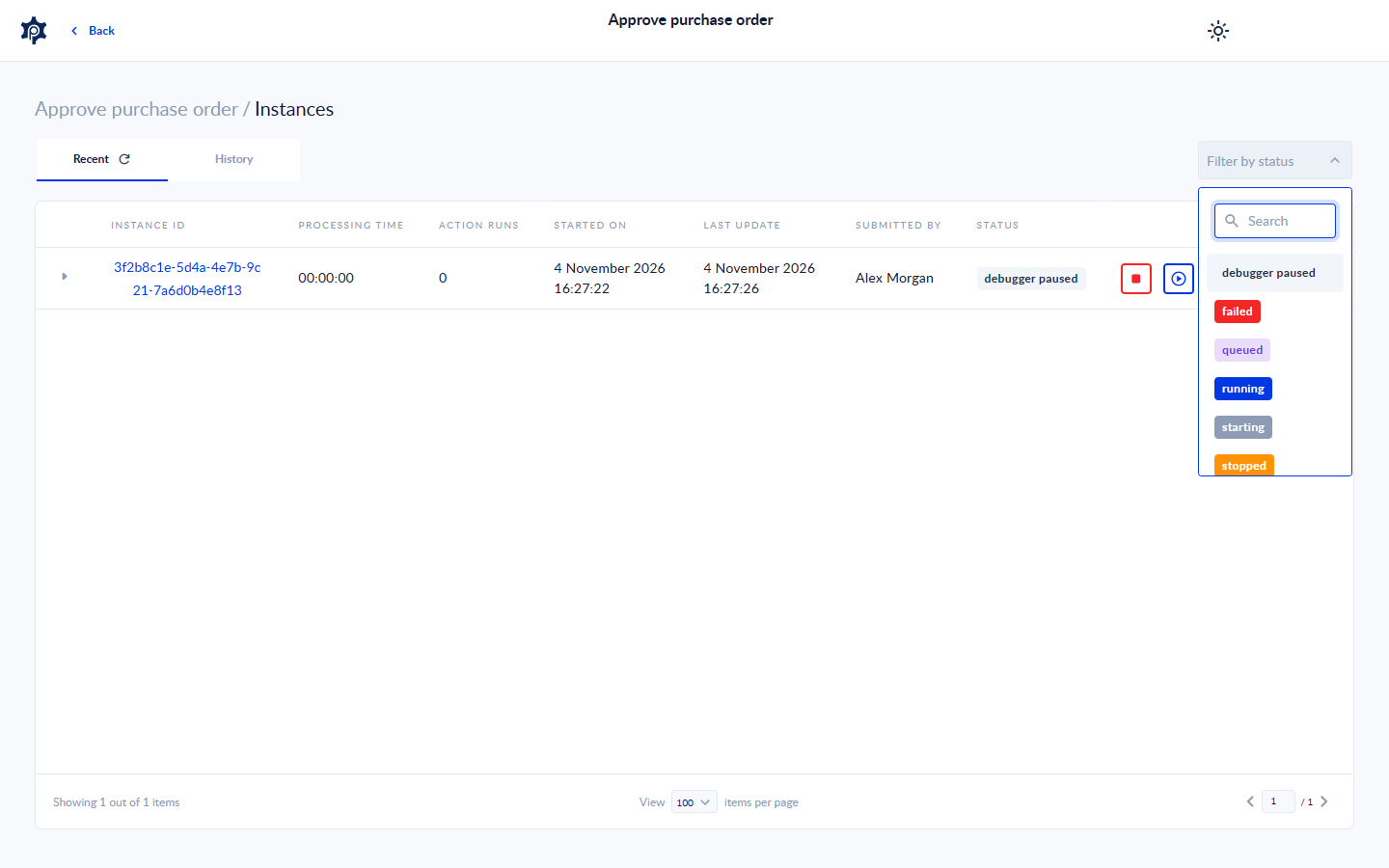
The run list
Each row is one run:
| Column | What it shows |
|---|---|
| INSTANCE ID | The unique ID of the run. Click it to expand the row and see the run's Input and Output variables. |
| PROCESSING TIME | How long the run's actions took. |
| ACTION RUNS | How many actions ran. |
| STARTED ON | When the run started. |
| LAST UPDATE | When the run last changed. |
| SUBMITTED BY | Who or what started the run: a user's name, or Schedule: <name>, Webhook: <name> or Form: <name>. |
| STATUS | The run's status (see below). |
At the end of each row:
- Stop instance (while the run is still running). See Stop a running process.
- Run instance with same input parameters starts a new run with the same input values.
- Refresh instance (while the run is still running) reloads its status.
- Show details opens the run's details.
Run statuses
| Status | Meaning |
|---|---|
| queued | The run is waiting for a free slot to start. |
| starting | The run is being prepared. |
| running | The run is in progress. |
| debugger paused | The run is paused at a breakpoint. See Debug a process. |
| success | The run finished. |
| failed | An action failed and the run stopped. |
| stopped | A user stopped the run. |
Filter the runs
- On Recent, use Filter by status to show only runs with one or more statuses.
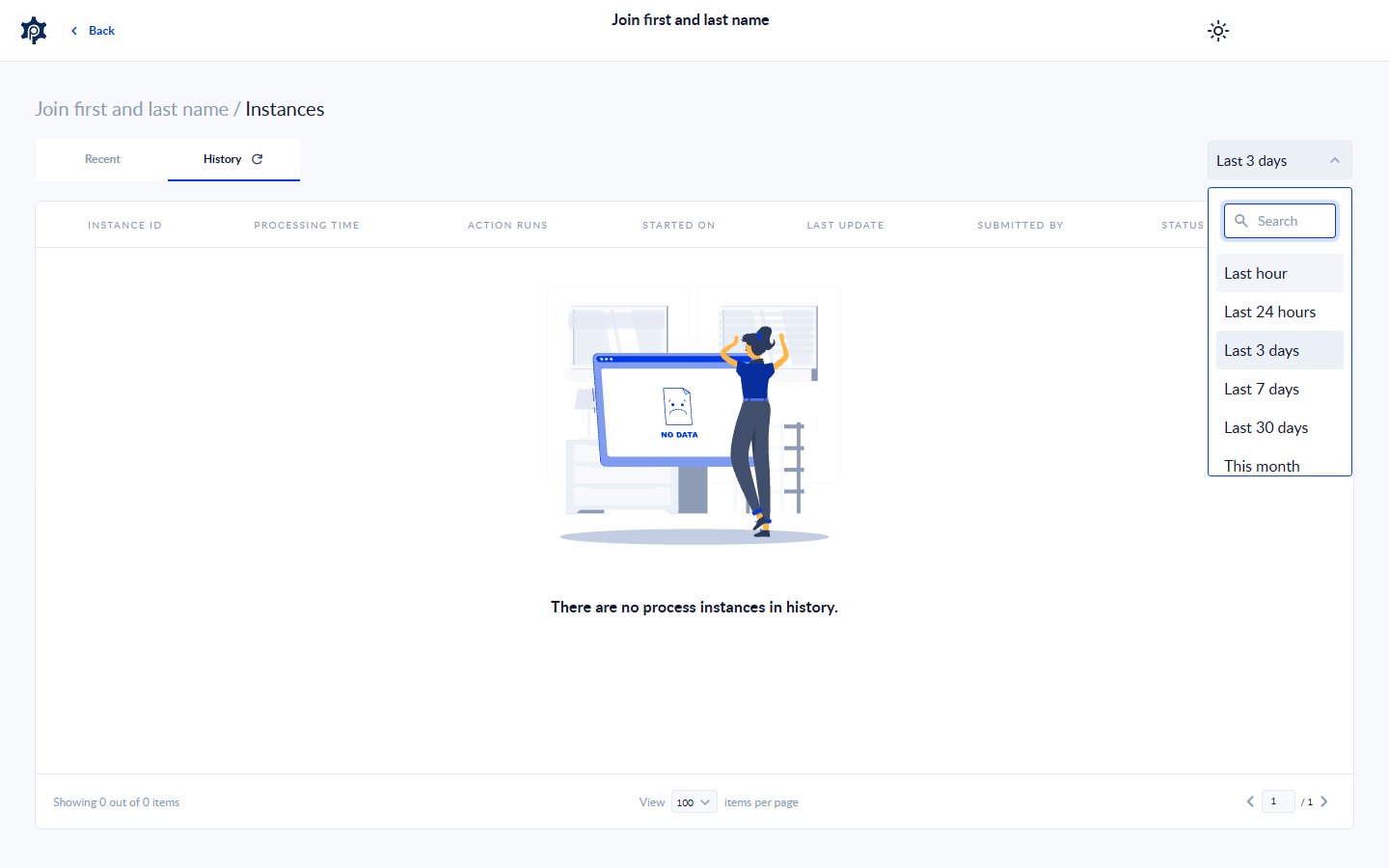
- On History, use Filter by date interval. You can pick Last hour, Last 24 hours, Last 3 days, Last 7 days, Last 30 days, This month, This quarter, This year, Last month, Last quarter, Last 3 months, Last 6 months, Last year, or Select a month... to choose one month.
Read a run's details
Click Show details on a run. The page shows the process as it was when it ran, with the state of each action. The action that is running right now is highlighted, so you can follow a run while it is in progress.
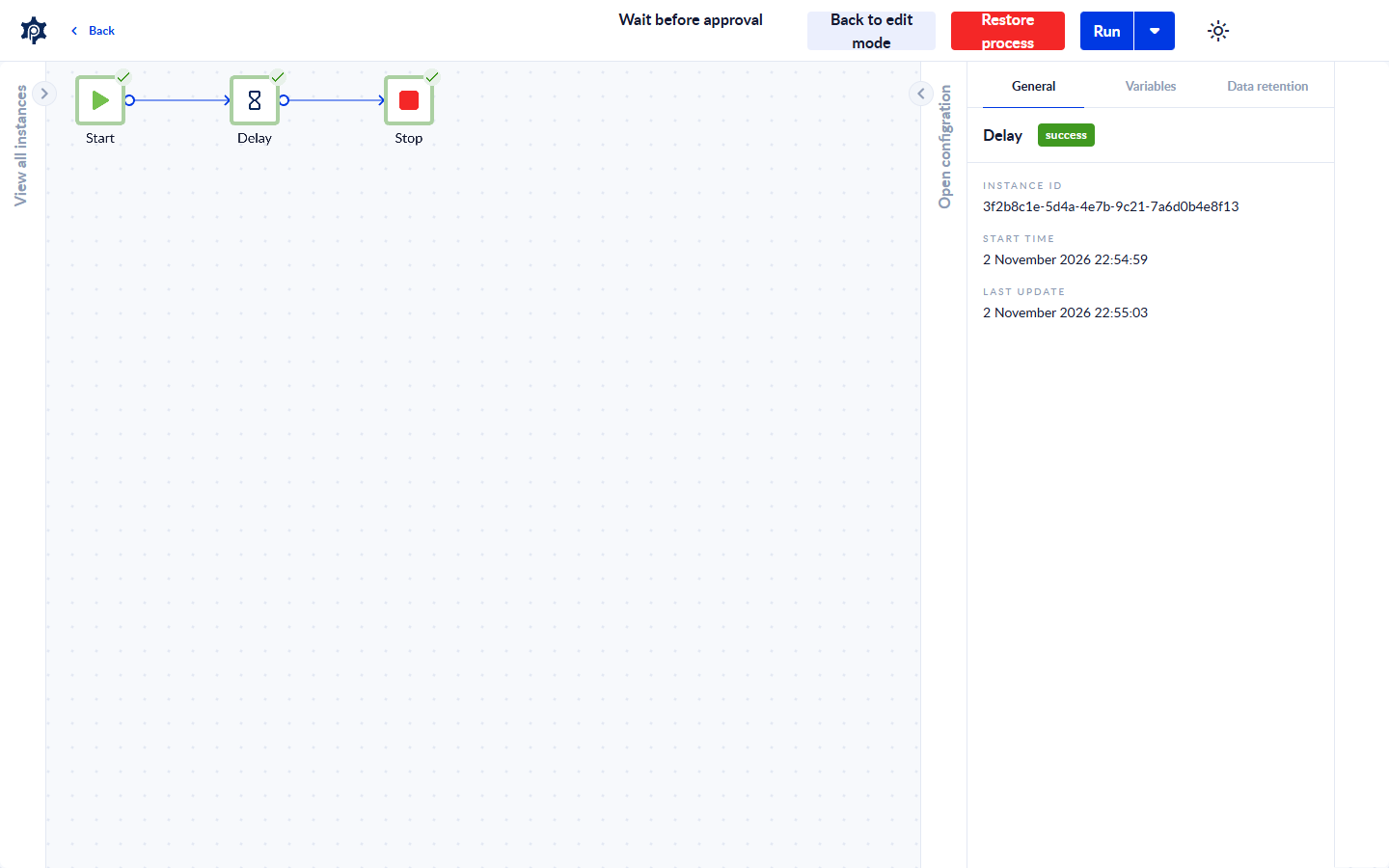
The panel on the right has three tabs.
General. With no action selected, it shows INSTANCE ID, START TIME, LAST UPDATE, SUBMITTED BY, SCHEDULE NAME, WEBHOOK NAME, FORM NAME, PROCESSING TIME and ACTION RUNS. Click the ACTION RUNS number to see the runs per action. If the run had errors, they are listed under Action errors.
Variables. With no action selected, it lists the run's variables in three groups: Input, Internal and Output. Use the search box and the Filter by check boxes to narrow the list.
Data retention. Here you can delete the data of this one run with Delete data of the instance. See Data retention.
Click an action on the canvas to see its own status, its error message if it failed, and the variables it used. An action that was disabled is greyed out and marked skipped.
While the run is still in progress, the panel also has Refresh instance and Stop instance buttons.
From the topbar of the details page you can:
- go back to the process with Back to edit mode;
- start a new run from the Run menu: Run with same input parameters, Run in debug mode, or Run in debug mode with same input parameters;
- restore the process from this run (see below).
Open a subprocess run
If the process uses Call Subprocess, you can open the runs it started:
- Click the Call Subprocess step, then the General tab.
- Under SUBPROCESS INSTANCE, click the run ID. The subprocess run opens in a new browser tab.
You can also double-click the step. If the step ran several times, for example inside a For Each, the tab shows SUBPROCESS INSTANCES with a numbered list in the order the runs started, and double-clicking the step opens a Subprocess instances list to pick from.
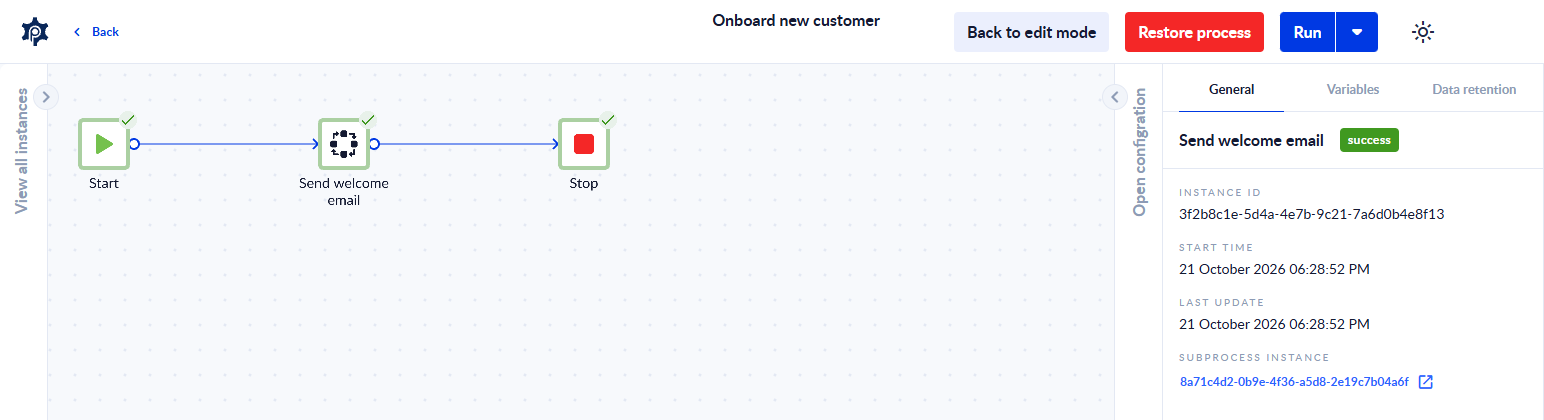
Values that PROCESIO records for its own use while a step runs, such as the ID of the subprocess run, are not listed with the variables. The subprocess link is where you find them.
Restore a process from a run
A run keeps the version of the process it ran with. If you changed the process since then and want that version back:
- Open the run with Show details.
- Click Restore process in the topbar.
- Confirm the dialog "Restore process from the instance version?".
The current version of the process is replaced by the run's version, and this can't be undone. If you may need the current version later, copy or export the process first.
You need permission to run processes to see Restore process. See User Permissions and Roles Management.