

API Keys
Create, name, rename and revoke the API keys that let other apps call the PROCESIO API, and learn the 25-key limit and the workspace rule.
An API key lets another app or script call the PROCESIO API without your password. With a key you can run a process, manage processes and work with the other resources the API offers. The key has the same permissions you have in the workspace.
To see what you can call, read PROCESIO API Documentation. To run a process with a key, see Running a process with API Keys.
Open the API Key page
In the left menu, open Automation and click API Key.
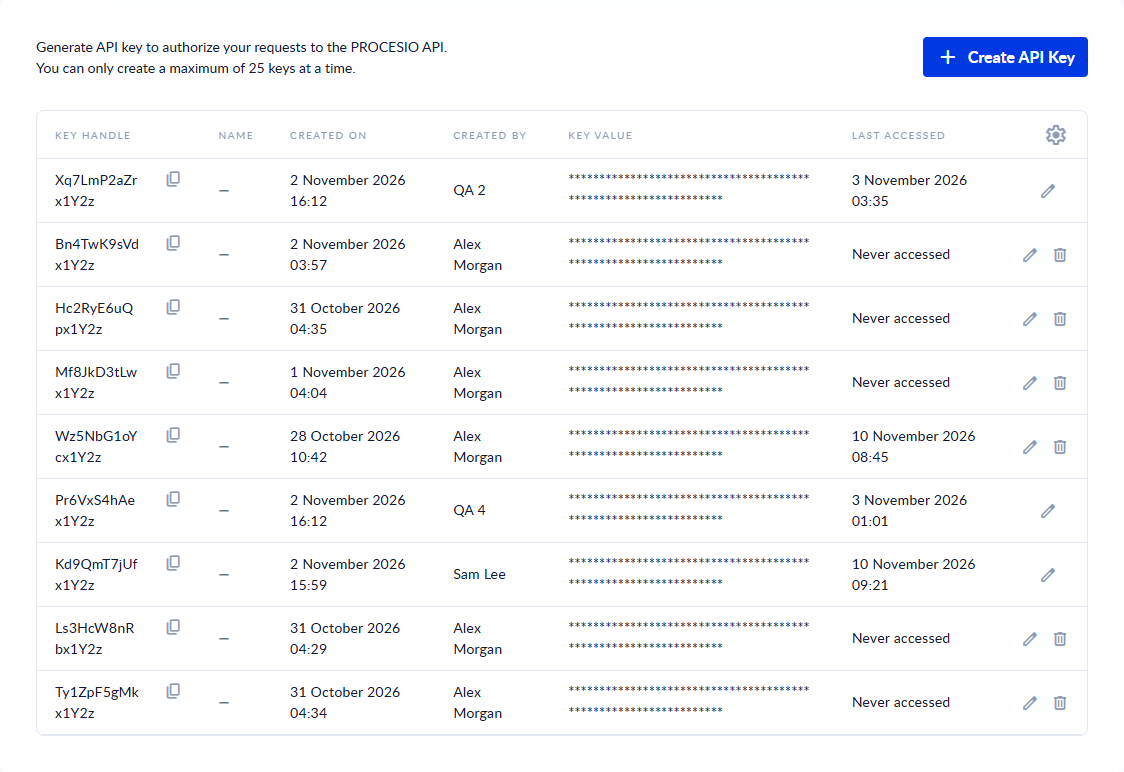
The table has one row per key:
| Column | What it shows |
|---|---|
| Key handle | The key's identifier, created by PROCESIO. You send it in the key header. It never changes, even when you rename the key. Click the copy icon to copy it. |
| Name | The name you gave the key, or — if it has none. |
| Created on | When the key was created. |
| Created by | Who created the key. |
| Key value | The secret part of the key. You see it only right after you create the key. After that it shows as asterisks. |
| Last accessed | When the key was last used, or Never accessed if it has not been used yet. |
Create an API key
- Click Create API Key.
- In the Create API key window, type a Name that says what the key is for, for example the app and the environment that use it. The name is optional, but it helps you tell your keys apart later.
- Click Create.
The new key appears in the table with its Key value visible.
Copy the key value now and store it somewhere safe, like a password. PROCESIO shows it only once: after you leave the page, it is hidden for good and cannot be recovered. If you lose it, create a new key and update the apps that used the old one.
A name can be up to 255 characters long. Two keys cannot have the same name: if the name is taken, the window shows "A key with this name already exists."
Rename an API key
- Click the edit icon at the end of the key's row.
- In the Rename API key window, change the Name.
- Click Save.
Renaming changes only the Name. The key handle and the key value stay the same, so apps that use the key keep working.
Revoke an API key
- Click the delete icon at the end of the key's row.
- In the Revoke API key? window, click Revoke.
The key stops working at once. Any app that still uses it is refused. Revoking cannot be undone.
Limits and rules
- 25 keys per workspace. You can hold up to 25 keys at a time in each workspace. When you reach 25, Create API Key is turned off, and the API refuses a new key with "The maximum number of Api keys has been reached." Revoke a key you no longer need to make room.
- A key works only in the workspace where you created it. It does not work in your other workspaces, and a key created in a shared workspace does not work in your personal workspace. Create a separate key in each workspace you want to reach.
- Each key belongs to the user who created it. You see and manage your own keys. In an enterprise account, the owner and co-owners of the master workspace also see the keys of every user in a workspace, with the user in Created by, and can rename them.
- A key cannot manage keys. To create, rename or revoke keys you must be signed in to PROCESIO.
- The key has your permissions. A call made with the key can do only what you can do in that workspace.
Use a key in a request
Send the key in these request headers:
| Header | Value |
|---|---|
key | The key handle. |
value | The key value. |
workspaceId | The ID of the workspace where you created the key. Leave it out for a key you created in your personal workspace. |
If your request also sends an x-version header, its value must be 1.19. Requests without the x-version header work as before.
For the full list of endpoints and an example, see PROCESIO API Documentation.