

Generate Document
Generate a filled-in PDF or HTML document from a Document Designer template, mapping your process data onto its variables.
After creating your template, use it in a process with the Generate Document action to produce a filled-in file.
-
Open the Process Designer and create your process.
-
Give it a name.
-
Drag the Generate Document action onto the canvas.

-
Create the process variables the action needs:
- fileout ➜ an output variable of type File, to receive the generated document.
- htmlstring ➜ an output variable of type String, to receive the generated HTML.
- Name ➜ an input variable of type String, one example of data you'll feed into the template.

-
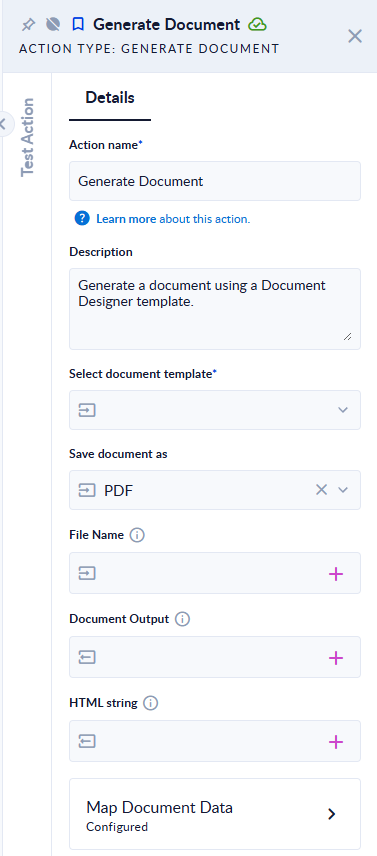
Click the Generate Document action to configure it:
- Select Document Template — pick the template you created.
- Save document as — PDF or HTML.
- File Name — the name of the generated file.
- Document Output — bind the fileout variable.
- HTML string — bind the htmlstring variable.
-
Click Map Document Data and map each template variable to a process variable or a typed value — the Name input variable created in the process, for example, to the Name variable used in the template (they don't need to have the same name). See Using the template for the full mapping reference, including Data Model attributes and list-bound tables.

-
Save, Validate and Run the process.
-
Running asks for the process's input variable values.

-
Click Run, then Check instance to see the run's output.
-
Click the download button to get the generated file or the HTML output.

The PDF file output:

Good to know
- The file extension (
.pdfor.html) is added to File Name if it is missing. - HTML string is filled for both PDF and HTML, so you can use it directly, for example as the Body of a Send Email with Body is Html ticked. In this output, double quotes (
") are replaced with single quotes ('); the generated file keeps them as written. - Table headers in the template cannot be bound to lists or data models; the step fails with "Please ensure no list data types are present in the table headers." or "Please ensure no data models are present in the table headers."