

Join
Brings two or more branches back together into one branch, for example after a Decisional.
Join brings two or more branches of a process back into one. Use it after a Decisional or an AI Decisional when the branches should continue with the same steps: instead of copying those steps into every branch, connect the end of each branch to a Join and continue from there.
Looking for the action that joins a list of texts with a separator? That is the String action Join.
Add the action
In the Process Designer toolbox, pick Join (or type Join in the search box). On the canvas it is a small circle.

Join has nothing to configure: no inputs, no outputs, no properties apart from its name.
- Drag Join onto the canvas.
- Connect the last action of each branch to the Join. A Join accepts any number of incoming connections.
- Connect the Join to the action that should run next. A Join has one outgoing connection.
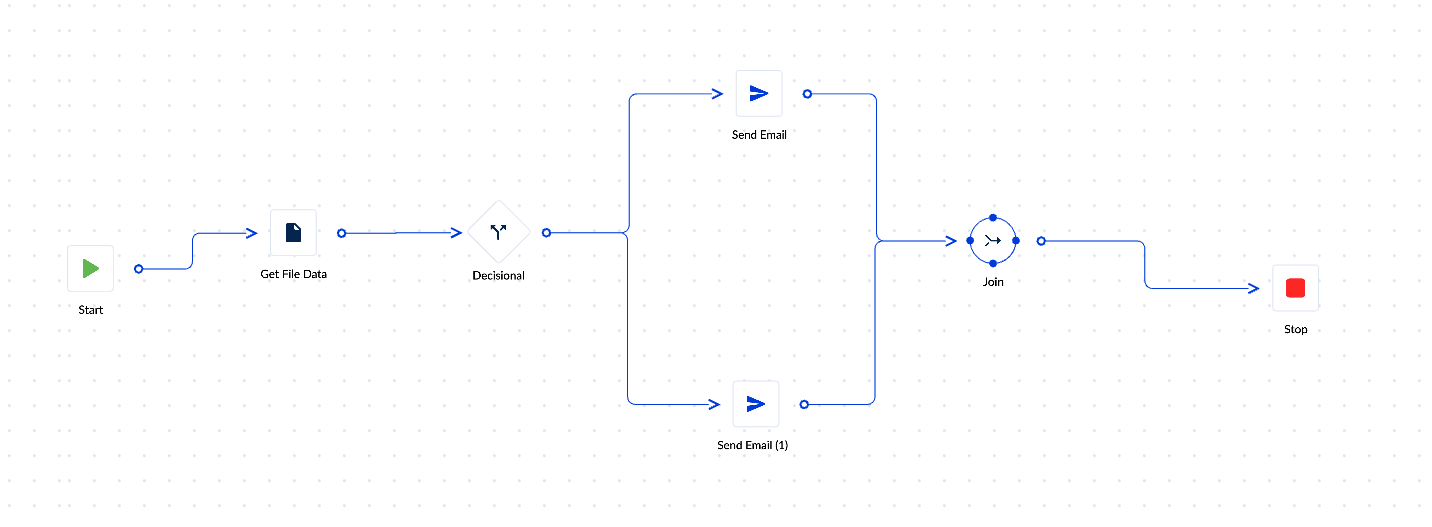
Example
A Decisional checks an invoice amount. The Large amount branch sends an approval email, the Default branch just logs the invoice. Both branches are connected to a Join, and the Join continues to a Data Store step that saves the invoice. Whichever branch runs, the invoice is saved once.
Good to know
- Only one branch has to arrive. A Decisional runs only one of its branches, so the Join continues as soon as the branch that ran reaches it; it does not wait for the others.
- A branch can be connected to any Join on the canvas, including one placed before or after the branch.
- Join cannot be disabled and cannot be run with Test Action: it only routes the flow.
- To send several cases of a Decisional to the same next action, connect each case to its own action, then join them; a Decisional case can target only one action, and an action can be the target of only one case.