

Simple Filter
Filters a simple list (text or numbers) with one rule written in a JSON configuration: exact, contains, similar, fuzzy, sound-alike, word match or regular expression.
The Simple Filter action keeps (or drops) the elements of a simple list — a list of text or numbers — that match one rule. You describe the rule in a small JSON configuration. To filter a list of data models or JSON objects by their fields, use Filter.
Add the action
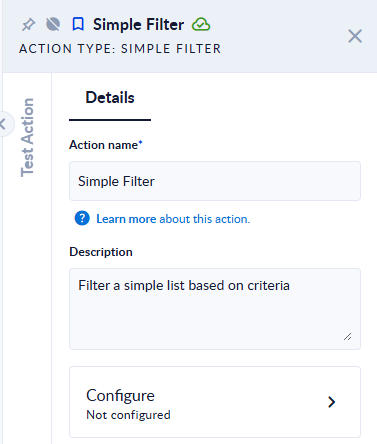
In the Process Designer toolbox, open List and pick Simple Filter (or type Simple Filter in the search box). Then click Configure to open the configuration panel.
Inputs and outputs
| Field | Direction | Type | Required | What to put / what you get |
|---|---|---|---|---|
| List to filter | Input | List of text or numbers | Yes | The list to filter, for example ["Apple","apple pie","Banana"]. |
| Filter JSON configuration | Input | Text (JSON) | Yes | The rule, see below. |
| Filtered list | Output | List of text | Yes | The elements that passed the rule, in their original order. |
The JSON configuration
{
  "MatchType": "Contains",
  "FilterExpression": "apple",
  "KeepIfTrue": true
}| Key | Required | Meaning |
|---|---|---|
MatchType | Yes | How each element is compared with FilterExpression: Exact, Contains, Similar, Fuzzy, Soundex, SimilarWordMatch or RegEx (not case-sensitive). |
KeepIfTrue | Yes | true keeps the elements that match; false keeps the elements that do not match. |
FilterExpression | Yes in practice | The value (or regular expression) to compare with. |
FuzzyAlgorithm, FuzzyThreshold | Only for Fuzzy | The similarity algorithm and the minimum score from 0 to 1. See Fuzzy. |
SoundexDistance | Only for Soundex | 0 to 4; 4 (the default) means "sounds the same". |
SimilarFirstNwords, SimilarLastNwords | Only for SimilarWordMatch | How many first / last words must be equal. |
Match types
Before comparing, each list element is converted to lower case, double spaces are reduced to one and accents are removed (București becomes bucuresti).
| MatchType | An element matches when… | Example with FilterExpression |
|---|---|---|
Exact | It equals the expression, ignoring case. | apple matches Apple, not apple pie. |
Contains | It contains the expression, or the expression contains it (ignoring case). | apple matches Apple, apple pie, pineapple. I like cherry juice matches Cherry. |
Similar | It matches after removing spaces, dashes, punctuation, www, http(s) and @; then one contains the other. Two phone numbers match when the digits of one contain the digits of the other. | apple-pie matches Apple and apple pie. 376-323-1111 matches 323-1111. |
Fuzzy | Its similarity score with the expression is at least FuzzyThreshold. | aple with Levenstein and 0.7 matches Apple. |
Soundex | It sounds like the expression in English. Numbers only match numbers and e-mails only match e-mails. | Jon matches Jon and John. |
SimilarWordMatch | Its first N words (or last N words) are the same as those of the expression. | apple tart with SimilarFirstNwords: 1 matches Apple and apple pie. |
RegEx | The regular expression finds a match in it. Always case-insensitive. | ^[0-9]+$ keeps only the elements made of digits. |
Fuzzy
FuzzyAlgorithm takes one of these names, written exactly like this (without spaces): BlockDistance, ChapmanLengthDeviation, ChapmanMeanLength, CosineSimilarity, EuclideanDistance, JaccardSimilarity, DiceSimilarity, Jaro, JaroWinkler, MatchingCoefficient, MongeElkan, Levenstein, NeedlemanWunch, OverlapCoefficient, QGramsDistance, SmithWaterman, SmithWatermanGotoh, SmithWatermanGotohWindowedAffine. An unknown name falls back to Levenstein. FuzzyThreshold is a number from 0 (anything matches) to 1 (identical); 0.7–0.9 is a good starting range. The algorithms are the same as in Similarity Search.
Example
List to filter: ["Apple","apple pie","Banana","Cherry","pineapple","Jon","John","10","25","3"]
| Filter JSON configuration | Filtered list |
|---|---|
{"MatchType":"Exact","FilterExpression":"apple","KeepIfTrue":true} | ["Apple"] |
{"MatchType":"Exact","FilterExpression":"apple","KeepIfTrue":false} | every element except Apple |
{"MatchType":"Contains","FilterExpression":"apple","KeepIfTrue":true} | ["Apple","apple pie","pineapple"] |
{"MatchType":"Fuzzy","FilterExpression":"aple","FuzzyAlgorithm":"Levenstein","FuzzyThreshold":0.7,"KeepIfTrue":true} | ["Apple"] |
{"MatchType":"Soundex","FilterExpression":"Jon","SoundexDistance":4,"KeepIfTrue":true} | ["Jon","John"] |
With the list ["Apple","10","25","a1","Bob Smith"]:
| Filter JSON configuration | Filtered list |
|---|---|
{"MatchType":"RegEx","FilterExpression":"^\\d+$","KeepIfTrue":true} | ["10","25"] |
{"MatchType":"RegEx","FilterExpression":"^\\D+$","KeepIfTrue":true} | ["Apple","Bob Smith"] |
{"MatchType":"RegEx","FilterExpression":"^[A-Z]","KeepIfTrue":true} | ["Apple","a1","Bob Smith"] (case-insensitive) |
With the list [10,25,3.5] and {"MatchType":"Exact","FilterExpression":"25","KeepIfTrue":true} the result is ["25"]: numbers come back as text.
Good to know
- Write the
FilterExpressionwithout accents. List elements lose their accents before comparison, but the expression does not, soBucureștinever matches; useBucuresti. - Backslashes in regular expressions must be doubled inside the JSON: write
"^\\d+$"for the pattern^\d+$. A single backslash makes the configuration invalid JSON and the step fails with The filter JSON configuration setting is not a valid JSON! - The result is always a list of text, even when the input list holds numbers.
- An unknown
MatchTypedoes not fail the step: nothing matches, so the result is empty with"KeepIfTrue": true(and the whole list withfalse). - With
SimilarWordMatch, set at least one ofSimilarFirstNwords/SimilarLastNwordsabove0; if both are0, every element matches. - The step fails when: the list is empty (The input list does not have any element!), the list contains data models (The input list is a Data Model! This action can only use simple lists.), or
MatchType/KeepIfTrueis missing.
Related actions
- Filter (lists of data models), Contains, Remove, DeDuplicate, Similarity Search
Filter
Filters a list of data models or JSON objects by one or more field rules written in a JSON configuration.
Find Duplicates
Finds duplicate records in a list of data models or JSON objects, using field rules from a JSON configuration, and returns the unique list, the duplicates and how they relate.