

Sort Data Model
Sorts a list of data models (or JSON objects) by one or more fields, each ascending or descending.
The Sort Data Model action sorts a list of data models (or JSON objects) by one or more of their fields — for example by city ascending, then by company name descending. The same list variable is used as input and output, so after the step it holds the sorted list. For simple lists of numbers or text, use Sort.
Add the action
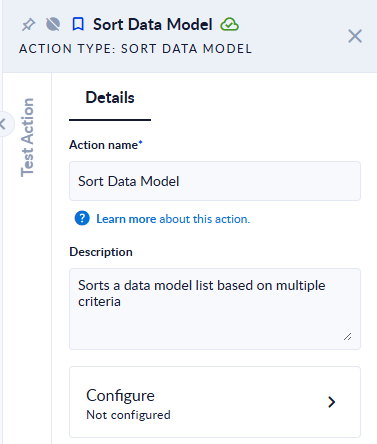
In the Process Designer toolbox, open List and pick Sort Data Model (or type Sort Data Model in the search box). Then click Configure to open the configuration panel.
Inputs and outputs
| Field | Direction | Type | Required | What to put / what you get |
|---|---|---|---|---|
| List to be sorted | Input and output | List of data models / JSON objects | Yes | The list variable to sort. After the step, the same variable contains the sorted list. |
| Sort JSON configuration | Input | Object (JSON) | Yes | The ID field and the sort rules, see below. |
The JSON configuration
{
  "IdField": "id",
  "Sort": [
    { "Field": "city",    "OrderType": "Asc" },
    { "Field": "company", "OrderType": "Desc" }
  ]
}| Key | Required | Meaning |
|---|---|---|
IdField | Yes | A field whose value is unique for every element (for example id). |
Sort | Yes | The sort rules, applied in order: the second rule only decides between elements that are equal on the first, and so on. |
Sort[].Field | Yes | A top-level field of the data model. Field names are case-sensitive. |
Sort[].OrderType | Yes | Asc (A→Z) or Desc (Z→A). |
Example
List to be sorted:
[
  {"id":"a","city":"London","company":"Nevett","employees":120},
  {"id":"b","city":"Berlin","company":"Rutherford Group","employees":9},
  {"id":"c","city":"Berlin","company":"Alpha","employees":45}
]| Sort | Result (ids in order) |
|---|---|
city Asc, then company Desc | b (Berlin, Rutherford Group), c (Berlin, Alpha), a (London) |
employees Asc | a (120), c (45), b (9) — sorted as text, see below |
Good to know
Values are always sorted as text, also numbers and dates. 120 comes before 45 and 9, because they are compared character by character. To sort numbers correctly, store them with the same number of digits (for example 009, 045, 120). Dates in the ISO format (2024-01-05) sort correctly as text.
- Text is sorted without regard to case:
A,a,b. - The
IdFieldvalues must be unique. With two elements that share the same ID, the result contains one of them twice and loses the other. - Only top-level fields can be used. A nested path such as
address.cityand a field that does not exist do not fail the step, but the list stays in its original order. - A list with a single element is returned unchanged.
- The step fails when the list is empty (The input list does not have any element!), or when
IdFieldorSortis missing.
Related actions
- Sort (simple lists), Filter, Find Duplicates, First N Elements
Find Duplicates
Finds duplicate records in a list of data models or JSON objects, using field rules from a JSON configuration, and returns the unique list, the duplicates and how they relate.
DeDuplicate
Finds duplicate values in a simple list (text or numbers) and returns the unique values, the duplicates and how they relate.