

Split Workbook
Splits one sheet of a workbook into several smaller workbooks with a fixed number of rows each.
Split Workbook cuts one sheet into parts of a fixed number of rows and saves each part as its own .xlsx file. Use it when a target system accepts only files up to a certain size, or to process a very large sheet in batches.
Add the action
In the Process Designer toolbox, open Excel and pick Split Workbook (or type Split Workbook in the search box).
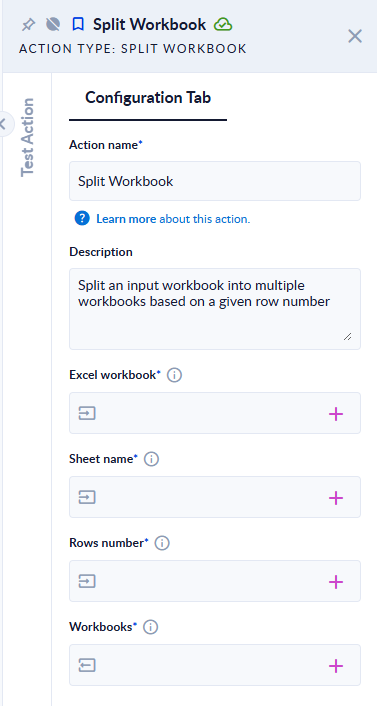
Inputs and outputs
| Field | Direction | Type | Required | What to put / what you get |
|---|---|---|---|---|
| Excel workbook | Input | File | Yes | The .xlsx or .xlsm workbook to split. |
| Sheet name | Input | Text | Yes | The sheet to split (case-sensitive). |
| Rows number | Input | Integer | Yes | How many rows go in each part, from 1 to 10000. |
| Workbooks | Output | List of File | Yes | The parts, in order. |
Example
orders.xlsx, sheet Orders with a header row and three data rows (4 rows in all), Rows number 2 → Workbooks:
| File | Content of its sheet Orders |
|---|---|
orders(Part1).xlsx | The header row and Pen |
orders(Part2).xlsx | Book and Mug (no header) |
Sheet name orders (lower case) → the step fails: "Sheet not found: orders".
Good to know
- The rows are counted from the first row of the sheet, header included. The header is not repeated in the later parts; add it yourself if the target system needs it.
- Each part has one sheet with the same name as the original. The other sheets of the workbook are not included.
- Formulas are copied as written, without shifting their references, so a formula can point to the wrong row in a later part. The last calculated values are kept.
- The parts are named after the original file:
name(Part1).xlsx,name(Part2).xlsx, … - Rows number
0fails with "…please input a value greater than 0."; more than 10000 fails with "…please input small value.". - To get
.csvparts instead, use Split Workbook To CSV.