

HTML Sanitizer
Removes scripts, event handlers and other unsafe content from HTML to prevent HTML injection, and can encode the result.
The Sanitizer action in the HTML folder cleans an HTML text that comes from outside, such as a form field, an email or an API, before you show it, store it or put it in a document. Scripts, event-handler attributes such as onclick and other unsafe content are removed; safe formatting such as <p> and <b> is kept.
Add the action
In the Process Designer toolbox, open HTML and pick Sanitizer (or type Sanitizer in the search box).
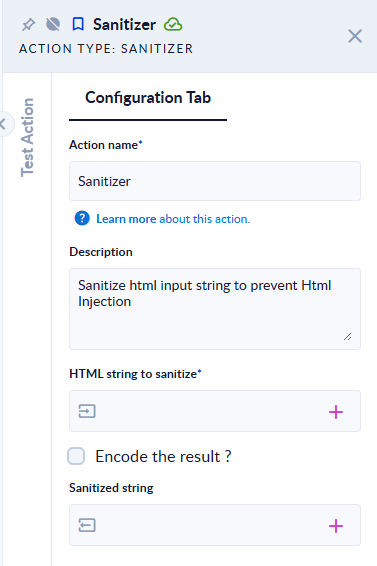
Inputs and outputs
| Field | Direction | Type | Required | What to put / what you get |
|---|---|---|---|---|
| HTML string to sanitize | Input | Text | Yes | The HTML to clean. |
| Encode the result ? | Input | Boolean (true/false) | No | Off (default): the output is clean HTML. On: the clean HTML is also encoded, so < becomes <, > becomes > and so on, and it shows as text instead of being rendered. |
| Sanitized string | Output | Text | No | The cleaned (and, if chosen, encoded) HTML. |
Example
HTML string to sanitize <p onclick="steal()">Hi <b>there</b></p><script>alert(1)</script>:
| Encode the result ? | Sanitized string |
|---|---|
| off | <p>Hi <b>there</b></p> |
| on | <p>Hi <b>there</b></p> |
Good to know
- Encoding is applied after cleaning, so the encoded result never contains the removed script.
- Use the encoded result when the HTML must be displayed as literal text (for example inside another HTML page); use the plain result when it must render as formatted content.
- An empty input returns an empty result; the step does not fail.
- HTML To PDF also removes scripts on its own before rendering.