

Import / Export resources
Export processes, data models, Data Stores, credentials, documents and forms to a .procesio file and import them into another workspace.
Use Import / Export to copy your work from one workspace to another. You export the resources you want into a file with the .procesio extension, then import that file in the other workspace.
You can export and import:
- Processes
- Data Models
- Data Stores
- Credentials
- Documents
- Forms
- Webhooks (export only, see Good to know)
Before you start
- You need the Admin permission on the workspace. Without it, the Import / Export button is not shown.
- Import / Export is not available in a master workspace. Open the sub-workspace you want to export from or import into.
- In your personal workspace you can export, but not import. The Import option shows "Import not available on Personal plan."
- You see only the resource types you are allowed to change in the workspace. If there is none, the dialog says "You do not have any available resources to Export. Please contact workspace's administrator." (or Import).
Open Import / Export
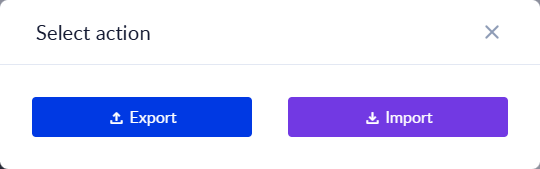
At the bottom of the left menu, click Import / Export. The Select action dialog opens with two options: Export and Import.
Export resources
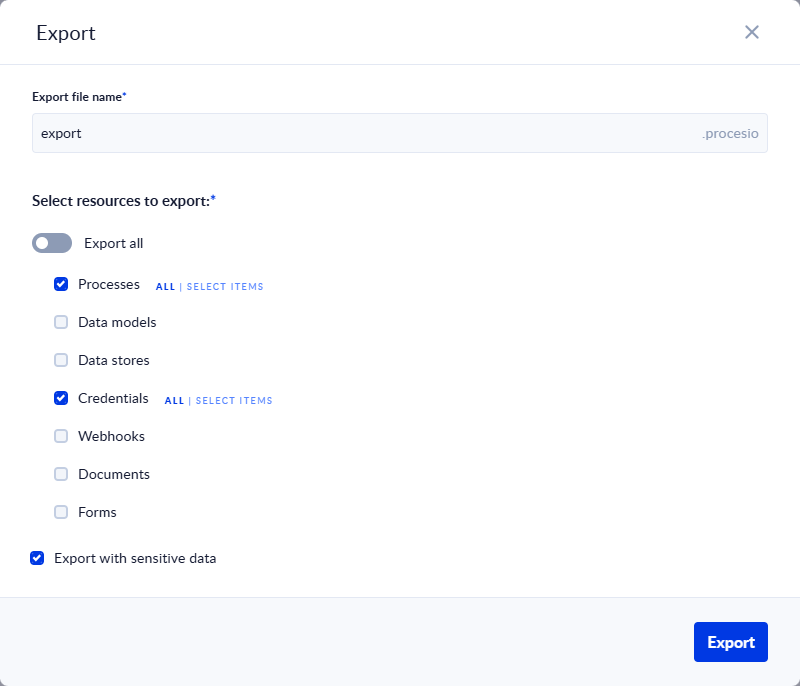
- Click Export.
- In Export File Name, type a name for the file. The default is
export. The.procesioextension is added for you. - Under Select resources to export:, choose what to export:
- Turn on Export all to export every resource in the workspace, or
- check the resource types you want. For each checked type, pick All (every resource of that type) or Select items (only the ones you choose).
- If you checked Credentials, you can also check Export with sensitive data to include the credentials' sensitive values in the file.
- If you picked Select items for a type, click Next to move through a tab for each type, for example Processes (0). Check the resources to include. Use Search by name to find them. The number in the tab shows how many you selected.
- Click Export. The
.procesiofile downloads to your computer, and the button changes to Close.
A file exported with sensitive data holds your credentials' secrets. Store and share it as carefully as the credentials themselves.
Import resources
-
Open the workspace you want to import into, click Import / Export, then Import.
-
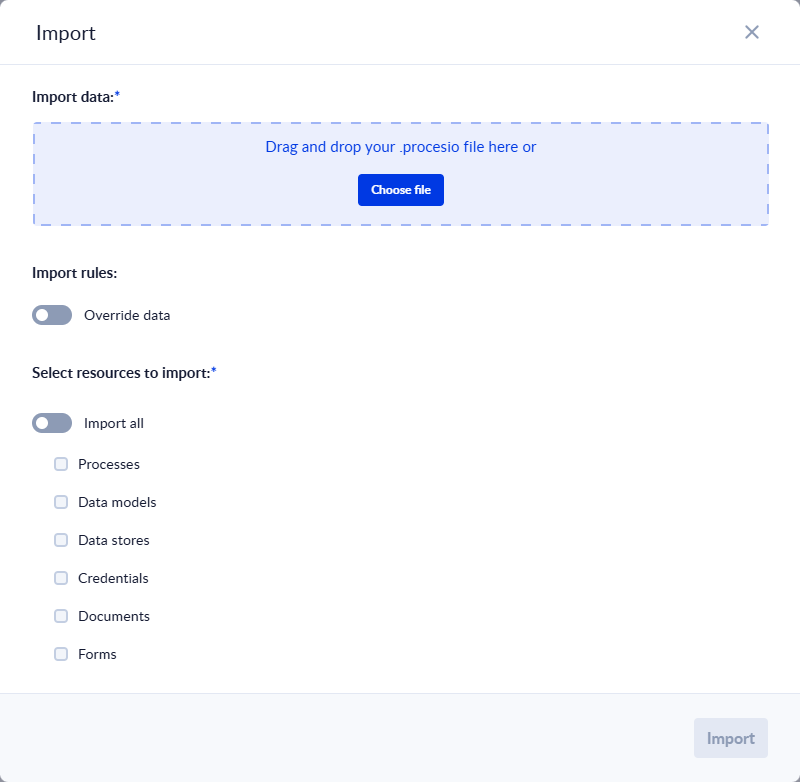
Under Import data:, drag your
.procesiofile into the box, or click Choose File. Only.procesiofiles are accepted; any other file shows "File format not supported." -
Under Import rules:, choose whether to turn on Override data:
- On: a resource in the file replaces the resource in the workspace that has the same ID.
- Off (default): resources whose ID already exists in the workspace are skipped.
Resources are matched by ID, not by name. A resource with the same name but a different ID is not replaced.
-
Under Select resources to import:, turn on Import all, or check the resource types you want to import from the file.
-
Click Import. When it finishes, you see "Import completed", and the button changes to Close.
Good to know
- Webhooks can be selected when you export, but the import has no Webhooks option and does not create webhooks. Create them again in the target workspace and assign them to their processes. See Webhooks.
- Exporting and importing also send messages to your Notification center, for example "Export completed" and "Import completed".
- If the import fails, you see "Import was failed" and nothing is imported. Check that the file is a
.procesiofile exported from PROCESIO and that you are in a workspace where import is available.