

REST API Credential
Store the base URL and the authentication of a web API once, so the Call API action and connectors can send requests to it.
A REST API credential holds what PROCESIO needs to call a web API: an optional base URL and the authentication (none, Basic, an API key, OAuth 2 or a client certificate). The Call API action and the connectors built on REST APIs use it. Secrets (passwords, key values, client secrets, certificate passwords) are stored encrypted and are masked when you open the credential again.
Create the credential
- Open Credential Manager and click Create credential.
- Enter a Credential name. In Credential type, open the REST API group and pick Create new REST API config.
- Optionally, add a Description and a Label. See Label.
- Click Next step, fill in the connection details below, test them, and click Save.
The rest of this page describes the connection details.
URL
URL is the base URL of the API, for example https://api.example.com/v1. Each Call API step adds its own Endpoint to it, so you can reuse one credential for every method of the API.
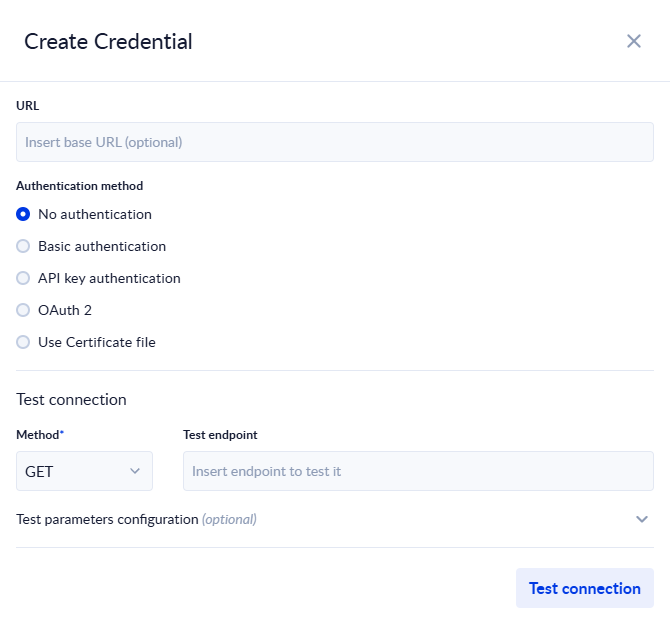
- The URL is optional. Leave it empty when the processes that use the credential call full URLs, for example when one API key works on several hosts. Each Call API step must then give a full
http://orhttps://address in Endpoint. - When you fill it in, it must be a full
http://orhttps://address, such ashttps://api.example.comorhttps://api.example.com:8443/v1. A path alone (/api/v1), an address without a scheme (api.example.com) and other schemes (ftp://…) are refused. The form shows Not a valid URL, and PROCESIO checks the value again when you save, so a credential can never be saved with a URL that cannot be called. - Do not put a user name and password inside the URL (
https://user:password@host). They are not used to sign in. Use Basic authentication instead.
The ready-made templates in the OAuth2 (REST API) group always keep the URL of their service. It is filled in for you and cannot be removed. See Predefined OAuth2 providers.
Authentication method
Choose how PROCESIO signs in to the API. The fields below the choice change with it.
No authentication
For public APIs. Nothing is added to the requests.
Basic authentication
| Field | What to enter |
|---|---|
| Name | The user name. |
| Password | The password. |
| Query Parameters | Leave it cleared to send the user name and password in the Authorization header (the usual way). Tick it only if the API expects them in the query string, as username and password. |
API key authentication
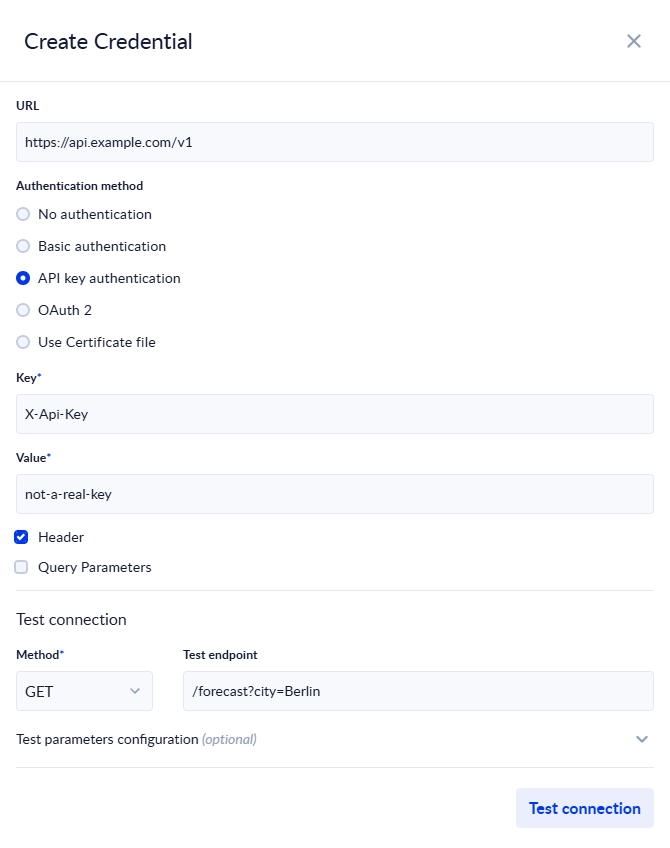
| Field | What to enter |
|---|---|
| Key | The name the API expects for the key, for example X-Api-Key or api_key. |
| Value | The key itself. |
| Header | Ticked by default: the key is sent as a request header, Key: Value. |
| Query Parameters | Tick it to send the key as a query parameter, ?Key=Value. Tick both boxes to send it in both places. |
OAuth 2
Use this for an API that signs you in through an OAuth 2 provider and has no ready-made template in the OAuth2 (REST API) group.
| Section | Field | What to enter |
|---|---|---|
| Scopes | The permissions to ask for. Your provider's documentation lists them. | |
| Copy OAuth Redirect URL | The address the provider sends you back to after you sign in. Copy it and add it to the allowed redirect URLs of your app at the provider. You cannot change it. | |
| Enter your Application Credentials | Client ID, Client Secret | From the app you registered at the provider. They may be called Consumer Key and Consumer Secret, or API Key and API Secret. |
| Add URLs | Auth URL | The provider's authorization address, where you sign in. |
| Access Token URL | The address where PROCESIO exchanges the authorization code for an access token. | |
| Refresh Token URL | Optional. Usually the same as the Access Token URL, and filled in with it when you type that one. When the provider returns a refresh token, Call API uses it to renew the access token, so your processes keep running. | |
| Advanced configuration (optional) | Extra parameters for the authorization, access token and refresh token requests, if your provider needs them. |
Click Save and authorize. PROCESIO saves the credential, opens the provider's sign-in window, and stores the token once you allow access.
Use Certificate file
For APIs that identify the caller with a client certificate.
| Field | What to enter |
|---|---|
| Certificate file | The certificate, as a .pem or .pfx file. |
| Certificate Password | The password of a protected .pfx file. |
A certificate in .p7b (PKCS #7) format does not load. Convert it to .pem or .pfx before you upload it.
Test the connection
The Test connection section sends one request with the details you entered, so you can check them before you save. It changes nothing in your processes.
| Field | What to enter |
|---|---|
| Method | GET. The test only reads, so it cannot change data by mistake. In a Call API step you choose any method. |
| Test endpoint | A path that answers a simple GET, added to the URL, for example /status or /users/me. |
| Test parameters configuration (optional) | Extra headers or query parameters for the test request. They are used only by Test connection, never by the Call API steps that use the credential. |
Click Test connection. The result shows next to the button and the API's answer below it. A credential that passed the test shows as validated in the Credential Manager.
Credential without a URL. There is no base URL to add the test endpoint to, so enter the full address in Test endpoint, for example https://api.example.com/status. With a path only, the test answers "This credential has no base URL. Enter an absolute test endpoint to test it."
Use the credential
Pick the credential in Select REST API credentials of a Call API step. The base URL and the authentication come from the credential; the step adds the endpoint, the method, the parameters and the body. The Call API page explains how the endpoint and the URL combine.
Working with Credentials
Create, test and use credentials in the Credential Manager, so your processes can connect to APIs, mail servers, file servers and databases without storing secrets in the process.
SMTP Server Credential
Most email accounts have two servers: one that lets you send emails to other people, and another that lets you receive the emails that other people…