

Working with Credentials
Create, test and use credentials in the Credential Manager, so your processes can connect to APIs, mail servers, file servers and databases without storing secrets in the process.
A credential holds the connection details for another system: a URL and an API key, a user name and password, an OAuth sign-in, a server address. You set it up once in the Credential Manager and then select it in every action that needs it, such as Call API, Send Email or a database action. The secret stays in the credential and never appears in the process.
For example, to work with the GitHub API, configure the authentication once in the Credential Manager. Then select that credential in every Call API action that calls GitHub.
Credentials belong to a workspace. Everyone in the workspace who may use credentials can select them in their processes.
Open the Credential Manager
In the sidebar, open Processes → Credential Manager. The list shows every credential in the workspace with its NAME, TYPE and STATUS, plus who created and last updated it and when. Use Search by name to find one.
STATUS reads validated once the credential passed Test connection, and not validated until then.
You can also open the Credential Manager from inside the Process Designer, from the sidebar menu of the canvas, to create or check a credential without leaving your process.
Credential types
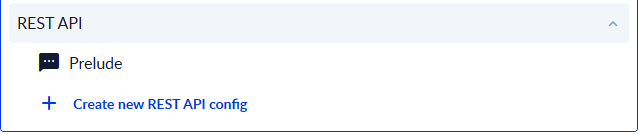
The Credential Type list is grouped. A group opens when you click it, and holds:
- ready-made templates for that type, for example the OAuth 2 providers or Prelude under REST API, with the address and settings already filled in;
- a Create new … config entry (for example Create new REST API config), which starts an empty credential of that type that you fill in yourself.
Type a few letters in the search box at the top of the list to filter it. Groups that contain a match open by themselves.
| Credential | What it connects to | Used by |
|---|---|---|
| REST API | Any HTTP API: no authentication, Basic, API key or OAuth 2 | Call API, connectors |
| OAuth2 (REST API) providers | Google, Microsoft, GitHub, YouTube and other services, with the OAuth 2 sign-in prepared for you. See below. | Call API, connectors |
| SMTP Server | An outgoing mail server | Send Email |
| SMTP Inbound | An incoming mail server (IMAP or POP3) | Read Mailbox, Read Mailbox V2 |
| FTP | An FTP or SFTP server | the FTP and SFTP actions |
| SQL | A database server | the database actions |
| Azure Storage Account | An Azure storage account, with a shared key or a service principal | Azure Storage |
| HashMac Key | A secret key for keyed hashes | Hash Mac |
Create a credential
- In the Credential Manager, click Create credential.
- Fill in Credential name. It is required and can have up to 50 characters.
- Pick the Credential Type: a ready-made template inside a group, or Create new … config for an empty credential of that type.
- Optionally, add a Description, so others know what the credential is for.
- Optionally, fill in Label (up to 50 characters). A connector that declares a connector type lists only the credentials labelled with it.
- Click Next step and fill in the connection details. The fields depend on the type; each type's page lists them.
- Click Test connection to check the details. The result shows as a status next to the button, and the server's answer appears below it.
- Click Save.
Back returns to the first step and keeps what you typed. If you close the panel from the connection details, PROCESIO asks you to confirm, because the details you entered are lost.
Predefined OAuth2 providers
The OAuth2 (REST API) group holds one template per supported service, for example Google Drive, Google Sheets, Google Calendar, Microsoft Teams, Outlook Mail, Sharepoint, Microsoft Graph, GitHub and YouTube Data. With a template you do not need to look up the provider's addresses:
- URL is filled in for you and cannot be changed.
- Scopes lists the permissions PROCESIO asks for. Remove the ones you do not need, add others, or restore the default list with the refresh icon. The panel links to the provider's documentation for scopes and endpoints.
- Test endpoint and its method are filled in, so you can test the credential right away. Test parameters configuration (optional) lets you add keys and values to the test request's header or query.
To connect, click Save and authorize (for Google services, the Sign in with Google button). PROCESIO saves the credential first, then opens the provider's sign-in window, where you sign in and allow access. If you click Save without signing in, the credential is saved as not validated.
In the list, these credentials show the type OAuth2 (REST API) / <provider>.
For a service that has no template, pick Create new OAuth2 config at the end of the group and enter the provider's details yourself. See REST API Credential.
Prelude
The Prelude connector sends and checks phone verification codes. Create its credential under REST API → Prelude and enter your Prelude API key.
Custom credential types
Some credential types are custom types rather than one of the built-in ones. They have no Test connection step, and the list shows no status for them.
Example: a credential for a dictionary API
This example creates a credential for the free Dictionary API, which looks up the meaning of an English word, and uses it in a process.
- In the Credential Manager, click Create credential.

- Fill in a name and a description, pick Create new REST API config in the REST API group, then click Next step.

- Enter the URL of the Dictionary API from its documentation and select No authentication, since the API has none.

- Click Save.
Test the credential later
The new credential shows in the list as not validated, because the example skipped Test connection.

To test it now:
- Open the credential to edit it, and click Next step to reach the connection details.

- Fill in the Test endpoint and choose the HTTP method. To look up the meaning of "automation" with GET, use
/automationas the test endpoint.

- Click Test connection, check the answer, then Save.

The credential now shows as validated.

Use the credential in a process
Each action that needs a credential has a field where you select it. A REST API credential is used by Call API. The page of each action and of each credential type says which goes with which.
- Create a process and its variables.

- Add a Call API action and select the Dictionary API credential.

- Save and run the process, then open the run to see the result.
