

Save action as a template
If you need to repeatedly use the same actions with the same configurations, you can save it as a template in your Toolbar. You can also disable an action you do not want to run, without deleting it.
If you need to repeatedly use the same actions with the same configurations, you can save it as a template in your Toolbar.
The video covers everything described on this page: saving an action as a template, using it, deleting it, and disabling an action you do not want to run.
How to save an action as a template
Step 1. Go to the Process Designer and open a new or existing process.
Step 2. Drag an action on the canvas and configure it.
Step 3. Right-click on the action and select "Save action as a template".
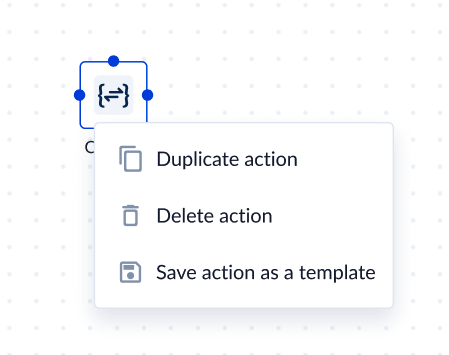
If the action is not properly configured, it cannot be saved as a template and a warning message will be displayed. HINT: You can press "Validate'' on top bar and the errors will be shown in the Errors Panel.
Step 4. A side-panel will open where the following must be configured:
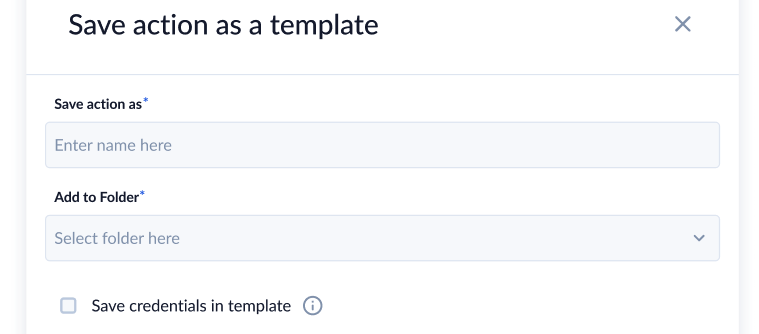
- Save action as: give a name to your template (note: the template saved will be visible under this name in the Toolbar)
- Add to folder (required): select the folder in the Toolbar where you want to add this action template. Saving without one fails with "Please select a folder from the list".
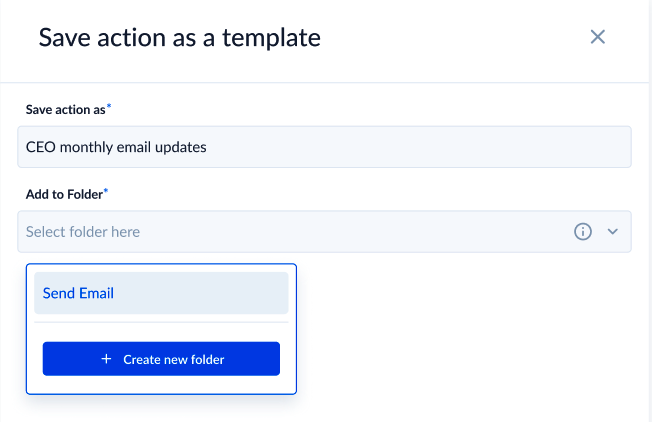
By default, an action template will be added under its main action type (e.g. a template saved based on a Call API action will be found in the Toolbar under the Call API action). You can create sub-folders under the main action if you want to better organize your action templates.
- Save credentials in template: this option is only visible for actions that include credentials as part of their configuration (e.g. Call API, Send Email). Check this box if you want the credentials to be saved along with the action configuration in the template. When using the action template in a process, you will no longer need to select the credential for the action, as it will be already selected.
Step 5. Press Save to save your action template. It will be reflected in the Toolbar under the selected/created folder.
To put the template in a new folder, open the Add to folder list and use Create new folder at the bottom of it, then type the folder's name. The Toolbar also has its own Create folder button, if you would rather set your folders up before saving anything.
An action template created will be visible in Toolbar to all users within the same workspace.
Using an action template
Drag and drop the action template on canvas and connect it to other actions.
The action template may need some last configuration steps to be taken:
- if it is created based on an action type that requires a credential, and the credential was not saved to the template, you may need to add a credential now so that the action works properly.
- if the template configuration included process variables, the process variables are replaced by a visual cue (red placeholder) to easily recognize where values are needed;
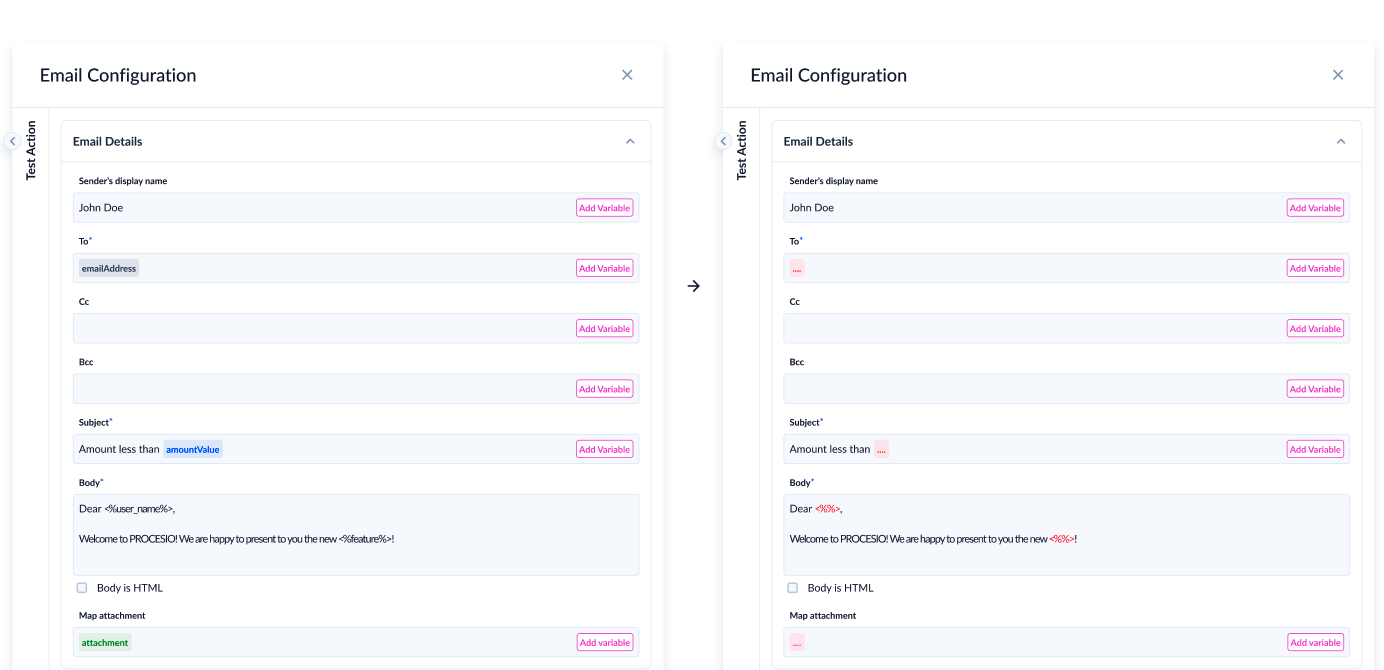
An action configuration that contains the red placeholders is not considered valid. When validating the process, all red placeholders will generate errors in the Errors Panel if they were not replaced with values.
You can save a template based on another action template, and it will be saved as a new template under its root action type/folder.
Managing templates and folders in the Toolbar
Both a template and a folder have a contextual menu in the Toolbar:
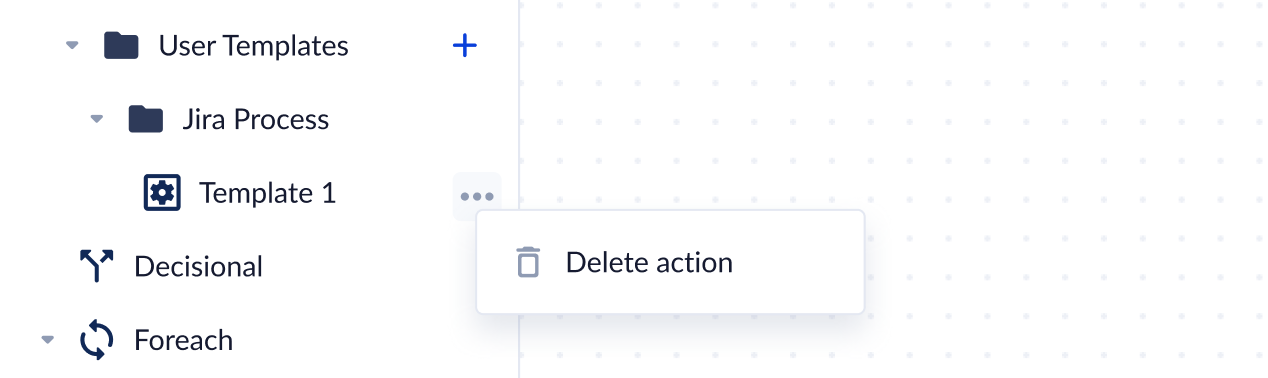
- A template can be deleted.
- A folder can be renamed or deleted. A folder has to be empty first — otherwise you get "The folder must be empty in order to be removed."
Deleting a template asks you to confirm, and cannot be undone. Nothing restores a deleted template — you would have to configure the action again and save it as a template a second time.
Deleting a template does not break the processes built from it. A template is a starting point: its configuration is copied into the process when you drag it onto the canvas, and the process keeps that copy. A process whose template is later deleted goes on running exactly as before.
Disabling an action
If you want to keep an action in the process but stop it from running, you can disable it instead of deleting it.
Step 1. Right-click on the action and select "Toggle disabled state". The option is only listed for actions that can be disabled.
Step 2. The action is shown faded on the canvas. Right-click it and select "Toggle disabled state" again to switch it back on.
Step 3. Save the process, so that the next run picks up the change.
A disabled action is skipped on every path it sits on, including the Error path of another action. The variables it would have written keep the values they had before, and in the process instance view the action is greyed out and marked as "skipped".
A disabled action is also left out of validation: if its configuration is incomplete, it will not raise errors in the Errors Panel.
Process Custom Response
Looking to integrate with a third-party app that requires a response in a specific format? The proposed PROCESIO solution is the Custom Response.…
Canvas shapes
Group and annotate a process with rectangles, ellipses and diamonds — shapes that organise the canvas without taking part in the flow.