

Using the template
Generate documents from your process data with the Generate Document action, and map process variables onto a template's placeholders.
After creating your template, use it in a process with the Generate Document action to produce a filled-in file.
-
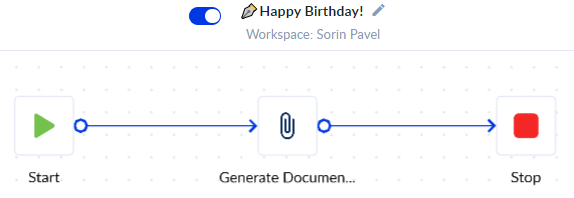
Open the Process Designer and create your process.
-
Give it a name.
-
Drag the Generate Document action onto the canvas.
-
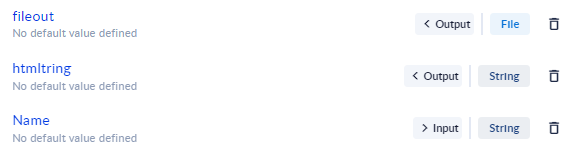
Create the process variables the action needs:
- fileout — an output variable of type File, to receive the generated document.
- htmlstring — an output variable of type String, to receive the generated HTML.
- Name — an input variable of type String, which is one example of data you'll feed into the template.
-
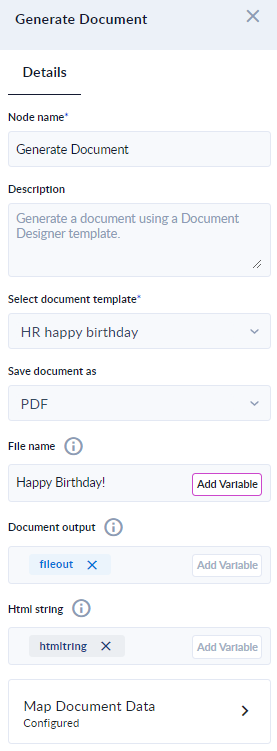
Click the Generate Document action to configure it:
- Select document template — pick the template you created earlier. Changing the template resets the mapping below to one empty row per template variable.
- Save document as — PDF or HTML.
- File name — the name of the generated file.
- Document output — bind the fileout variable.
- HTML string — bind the htmlstring variable.
-
Click Map Document Data, then map each template variable to a process variable (or a literal value/expression):
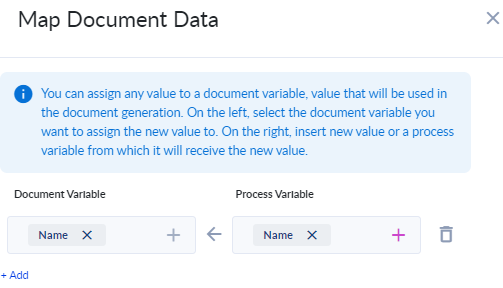
- Document Variable (left) lists the template's own variables — you can't type free text here, just pick which one you're filling in.
- Process Variable (right) accepts either a process variable or a typed value/expression — this is where you supply what fills the placeholder. They don't need matching names: map the process's Name variable to the template's own Name placeholder, for example.
- A template variable of a Data Model type expands into its own attribute rows, so you can map each field individually (the same
variable.attributeaddressing a pill uses in the editor). - A row with an empty Document Variable is flagged "Field is required" when you try to validate or run the process — map it or remove the placeholder from the template.
A list-typed Data Model variable (used by a Dynamic Table) is mapped the same way, as one binding to the whole list — the table then repeats once per item at generation time.
-
Save, Validate and Run the process.
-
Running asks for the process's input variable values.
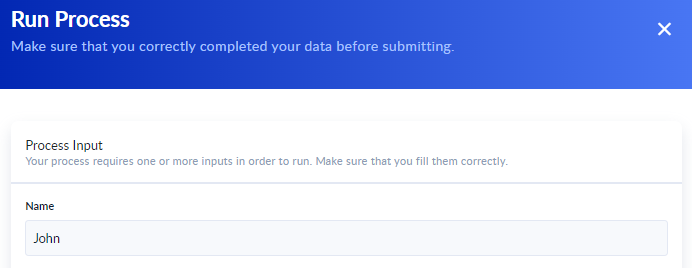
-
Click Run, then Check Instance to see the run's output.
-
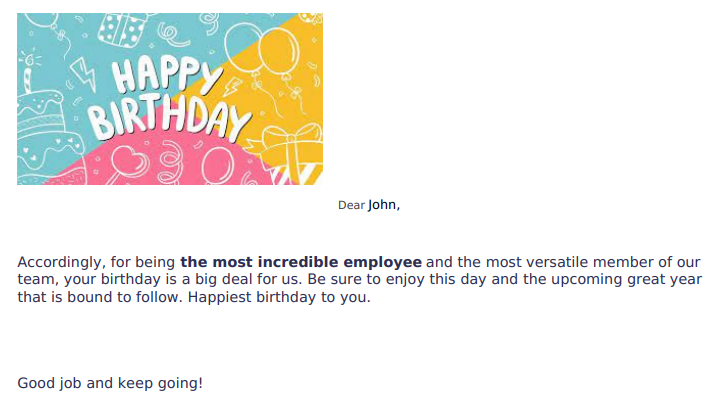
Click the download button to get the generated file or the HTML output.

The PDF file output:
Document template creation
Build a document template in the Document Designer: variables, data-model tables, formatting, Code View and everything else the editor offers.
Data Store
A table you define and fill inside a workspace — rows and columns you can read and write from a process, from a form, or through the API.